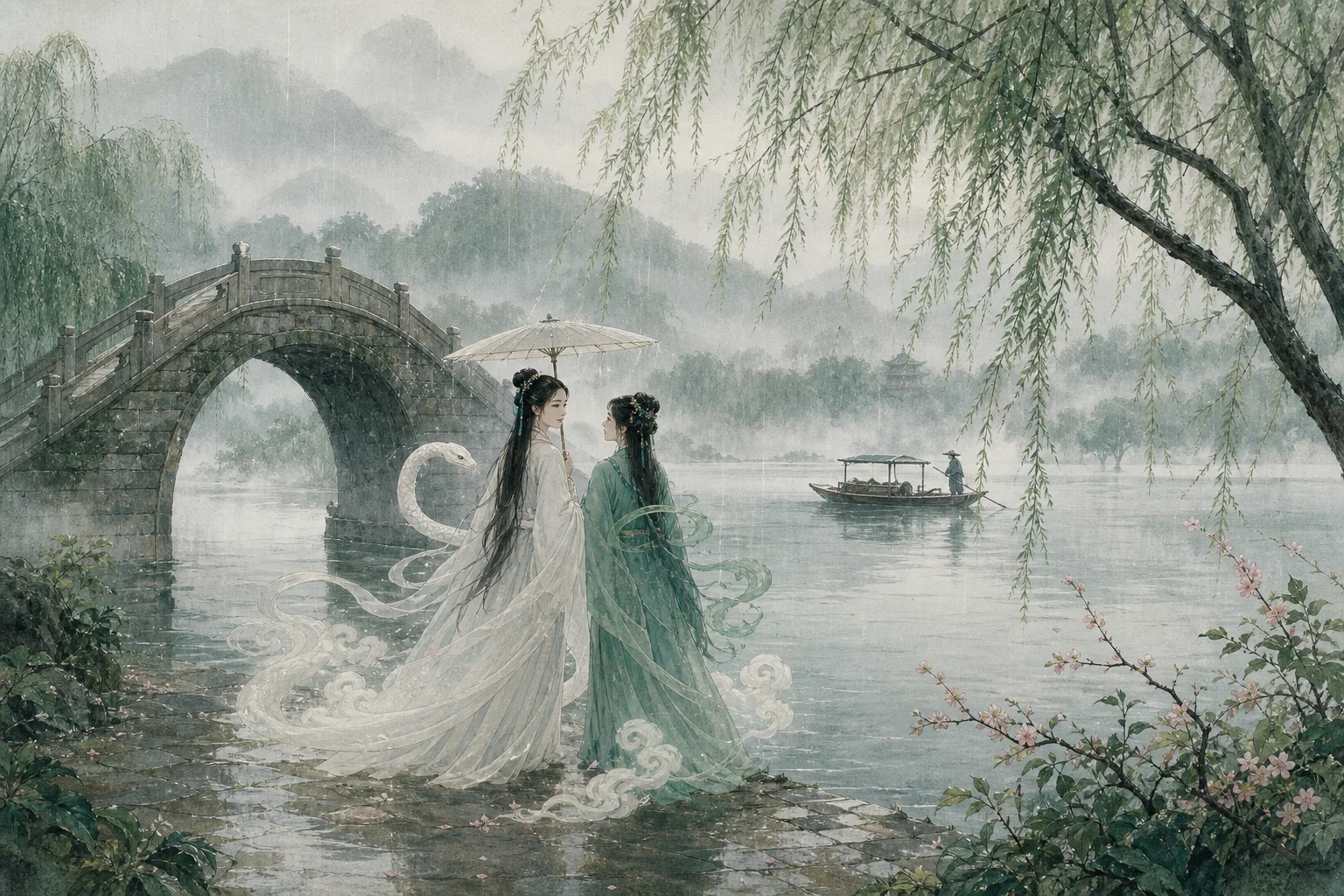
Mist, rain, willow branches, and the bridges of Hangzhou's West Lake form the landscape of the White Snake legend. Bai Suzhen, a white snake spirit who has cultivated the power to take human form, travels with her companion Xiaoqing. At Broken Bridge she meets the scholar Xu Xian, and an umbrella offered in the rain becomes the beginning of their bond.
The couple marry and build a life together, often associated with a medicine shop and acts of healing. Yet their household crosses a boundary between human and spirit worlds. The monk Fahai sees that boundary as dangerous and attempts to expose Bai Suzhen's true form and separate the pair.
Monster, healer, wife
The emotional meaning of the story depends on how Bai Suzhen is portrayed. Earlier snake-spirit tales could emphasize danger and deception. Later versions increasingly present her as devoted, compassionate, and unjustly persecuted. A supernatural being once framed as a threat becomes the moral center of a love story.
Transformation here is more than disguise. Bai Suzhen learns, loves, heals, suffers, and forms obligations in human society. The question is not whether she was born human, but whether her actions and attachments make her humanity meaningful.
A legend shaped by performance
The White Snake legend has no single final form. Storytellers, local traditions, opera stages, novels, films, and television have changed its characters and ending many times. West Lake anchors those variations in a real place. Visitors can stand near Broken Bridge and see how geography, weather, and performance continue to keep a legend alive.