The grain stays where it is
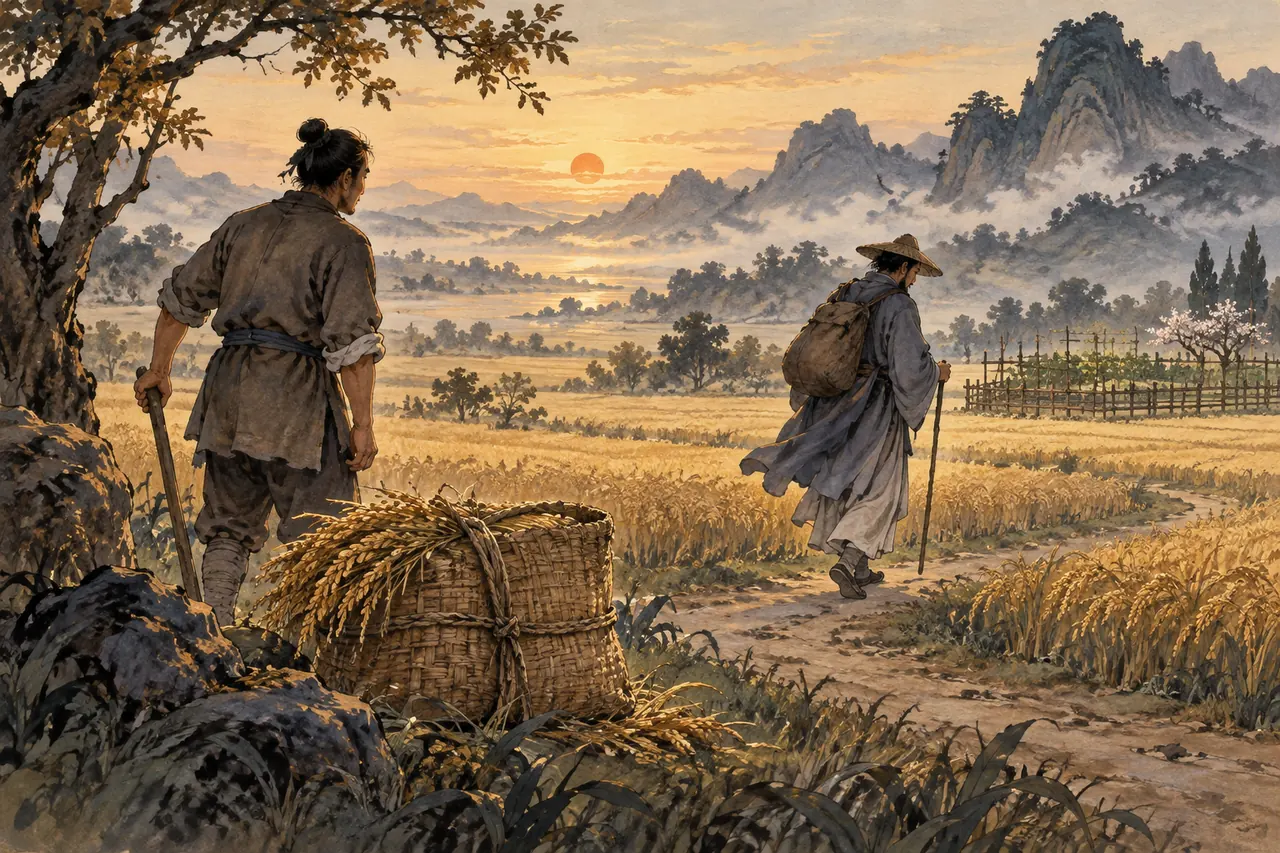
The farmer has more grain than he can eat. He leaves the rest at the edge of his field and goes home. When he comes back in the morning, it is still there. Someone must have walked past it in the night. Nobody took a handful.
Under Donghu, this is ordinary. A traveller who drops something on the road can return for it. People are not guarded by walls or patrols; they are guarded, if that is the word, by a shared reluctance to profit from a neighbour’s loss. Donghu sees no reason to improve the arrangement. He is a ruler who knows how to leave a good habit alone.
It does not last. Much later, Xuwei finds a stretch of trees and flowers and asks people to make him a garden. They thin the woods, move stones, bring water into a pond, and draw a boundary around the result. The work seems gentle beside a battle. It changes the way a person can look at land: here is a place made for me; what lies outside belongs to somebody else, or to nobody yet.
The change matters because the people before Xuwei have so little to guard. Some live like quail, sleeping here one night and in another village the next. They eat what they find and join whoever is going out at sunrise. Their freedom comes with cold, hunger, and exposure. Yet they can also put down a possession and expect to see it again. The garden will offer a different pleasure. Its fence will ask a new question: who may enter?
A different world in Shu
After Chenfang’s descendants, the line turns toward Shu. Its first three rulers are Cancong, Bohuo, and Yufu. Cancong lives at Qushang; Yufu governs from Daojiang to Pugang; people wear their hair in coils and fold their clothing to the left. Marriages later connect the descendants of the Yellow Emperor with women of the Shu Mountain clan.
The people of Shu have their own rulers, places, clothing, and marriage ties. Human life is already varied across regions. Even in a legendary age, there is no single way for everyone to dress or trace a lineage.
The details make Shu feel like somewhere, not just a name on a long list of rulers. You can picture people with their own way of wearing their hair, their own folded clothes, and stories about who married whom. We do not get a full account of an ordinary day there, but these small markers suggest that distant communities had their own habits long before anyone drew neat borders on a map.
The world widens from a common struggle against cold to places with their own customs. The Shu names are few, yet they prevent this early age from looking like a single village stretched across the earth. A distant community can belong to the wider human story without losing its local character.
The Shu rulers remain in place for hundreds of years each, according to the old account. Their wives receive the title of consort and are buried with them. Such details do not fill in the daily life of their subjects, but they suggest a society with recognizable ways of naming, mourning, and remembering a ruling house. The coiled hair and left folded clothing are also more than ornaments in the description. They let one community appear different from another before a map could make that difference easy to see.
Huikui and Hundun are followed by Donghu. In Donghu’s time, trust becomes visible in the smallest acts.
The day nobody stole the grain
Animals multiply in herds and forests become thick. If people find something another person has dropped on the road, they do not take it for themselves. Farmers with more food than they can consume leave it at the ridge of the field overnight, and nobody steals it.
No police force, court, written code, or punishment protects those goods. People have not learned to make private gain out of another person’s loss. Surplus food has not become an invitation to theft. Their trust is a habit practiced before anyone orders it.
Donghu refuses to manufacture distinctions. If people are taught too strongly to divide “self” from “other,” he fears, they will learn cunning. He remains quiet and composed, preserving the ease inherited from a rougher age. People throughout the nine regions follow his example.
Donghu does not take credit for the trust people already show one another. He simply avoids getting in its way. There is no need to add rules just so everyone can see that a ruler is doing something.
Their happiness has a particular texture. When people are glad, they laugh and sing together without turning the occasion into a chance to mock someone else. When grief comes, they weep for themselves without making a display of it. The same restraint that leaves grain on the field ridge also governs speech and emotion. People neither take what a neighbour has dropped nor use a neighbour’s misfortune for entertainment. Donghu’s silence as a ruler fits this quieter society.
Imagine dropping a bag on the road and only noticing when you are halfway home. In this world, you can turn around without expecting an empty patch of dirt. Someone has seen the bag and left it there. The farmer does the same in a different way: grain stays in the field overnight because nobody thinks a neighbour will steal it. Trust is not a grand speech. It is the decision to keep walking without clutching every possession.
He seems to know when to stay out of the way. People leave grain by the fields and lost things on the road, so he lets that habit grow instead of putting officials around every corner.
Six phoenixes land in the garden
After Donghu comes Huangtan, also called Liguang. Six phoenixes appear during his reign. Their many coloured bodies move through clouds; they do not break living grass beneath their feet or perch with ordinary waterfowl. They descend in recognition of Huangtan’s virtue.
Huangtan’s response is measured. He observes the natural world, considers the arrival of the phoenixes a good sign, and calls to them in song: “Phoenix, phoenix, come to me. Phoenix, phoenix, will you not stop for me?” The birds arrive.
Huangtan neither traps the birds nor claims to own them. He recognizes them, calls to them, and receives them. Their visit is a sign of a world at ease with its ruler, not a possession he can display at will.
Abundance in Donghu’s forests and phoenixes in Huangtan’s sky belong to the same imagined order. Later, people and animals live within an atmosphere compared to spring. The signs of a good reign appear in the world around it: in what grows, what visits, and what can pass without fear.
The phoenixes refuse to tread on living grass. That detail places restraint even in the feet of the auspicious birds. Huangtan calls rather than captures them, singing for them to come and rest. Their arrival answers an invitation. There is no cage, hunt, or prize, and nothing in the encounter suggests that the birds would remain if the conditions that drew them changed. The good sign is a living visitor, free to leave.
No one asks where you slept
Huangtan is followed by Qitong, then Jiyi, then Jiju. Qitong conceals himself and avoids display, yet his favour reaches the world. People and creatures do not harm one another; the multitude lives in an atmosphere compared to spring.
In Jiju’s era, people do not visibly distinguish government from disorder. At sunrise, they go out in groups: holding hands, touching shoulders, gathering plants, watching fish, and following their own preferences. As the day grows late, each person seeks the place and companions they like. Some return early; some late; some stay out overnight; some travel with different groups. Men and women love one another freely. Children recognize their mothers, but not fathers.
There is no fixed marriage, paternal recognition, or permanent residence. The looseness of kinship belongs to the same way of life as their mobility and shared food. People find companionship without asking each other to prove a claim of ownership.
They are called “those who know life.” They travel in loose groups, sharing winter sun and summer shade. They eat where they find food and drink where they find water. They laugh when happy and grieve when someone dies; there is no grand funeral system yet, and the wind takes the bodies.
Their days do not run according to a fixed household schedule. A group goes out at sunrise; by evening its members may divide according to affection or whim. One person returns early, another stays away, another joins a different company. The ability to move makes these choices ordinary. No one seems obliged to explain where they slept, with whom they ate, or why they crossed into another village. A life with so little property can also make fewer demands on a traveller’s time.
The absence of a recognized father changes how children belong. They know the mother who bore them, while the later insistence on a father’s name has yet to arise. The detail is easy to isolate, but it belongs with the rest of their unsettled life. A community that moves together and divides again by evening has little reason to build the elaborate lines of descent that later households will use to arrange inheritance, duties, and marriage.
A life with no fixed address
They live “like quail,” with no permanent dwelling, in one district today and another village tomorrow. They feed “like nestlings,” looking for food wherever they are. The comparison puts them close to the animal world, before fixed settlement and accumulated property.
The life is unstable and exposed, yet its mobility and minimal possessions leave little room for theft, jealousy, and status competition. People do not demand things from others or organize every relation around a fixed family claim. They give up the security of durable structures and avoid some of the conflicts those structures can bring.
Human beings need protection from cold and rain. They need food and companionship. Their scattered lives provide some of these things and leave others uncertain. When they begin to make permanent boundaries, they gain one kind of safety and invite another kind of trouble.
Even the bird comparisons cut both ways. A quail can settle wherever it finds cover, and a nestling receives what is at hand. Neither keeps a granary or locks a door. Yet neither can count on a roof during black frost. The old freedom and the old vulnerability travel together. Chenfang’s bark garments show that care can enter this world without enclosing it; Xuwei’s garden will show what happens when an improvement begins by drawing a line around a place.
The ruler who fenced off a garden
After Jiju, Xuwei makes gardens and parks for his own enjoyment. Seeing dense trees and tangled grasses, he orders people to cut back some trees, thin some vegetation, and establish boundaries on all four sides. The place becomes visibly different. He channels spring water into ponds, moves flowers, and sets stones in place. The work does not appear to exhaust the people.
The garden is a modest work of landscape design, yet its appearance coincides with a thinning of the earlier ease. An old poem recalls a time when ruler and people were calm and all things flourished; then customs changed and possessiveness grew. The newly arranged garden stands at the edge of that change.
Xuwei’s work does not look like forced labour. The garden is beautiful. Yet once a ruler selects, clears, divides, encloses, and beautifies space for personal enjoyment, the world is no longer simply shared and unbounded. Even a harmless boundary can begin to change how people think about what belongs to whom.
Those living outside the enclosure may still admire it. No quarrel over the garden is recorded, and no one is said to have been expelled. The change is quieter: an owner can now point to a pleasant place and say that its shape was made for him. The water, flowers, stones, and trees are part of an arrangement from which others may be absent. That possibility did not exist when people moved through an open landscape as they pleased.
The water, flowers, and stones are pleasant to look at. What changes is the ruler’s ability to call the whole arrangement his own. Once the landscape becomes “mine,” everyone else has to learn where that claim begins and ends.
You can almost watch the garden take shape: workers cut back some trees, pull up grass, guide spring water into a pond, and carry flowers and stones to new places. Nothing here is violent like a battle. Still, the beauty comes from choosing what stays and what goes. Xuwei now has a corner of the world arranged for his own pleasure, set apart from the land everyone used to wander through.
The poem that follows does not say exactly when a pleasing enclosure becomes a harmful one. Its regret lies in the slow shift of custom. Ruler and people once lived calmly among flourishing things; later they began to divide things and self more sharply. The garden can be enjoyed, but it also gives the eye practice in distinguishing what has been made for an owner from what simply grows. Its fence can be crossed, yet the thought behind it may linger.
The old dream comes back
Many reigns later, the Yellow Emperor’s world is described in terms that Donghu might recognize. City gates stand open. No one cheats in the market or fights for gain. Officials have no private schemes. Tigers and leopards do not attack at random; the rains arrive when they are needed. The picture is impossibly generous, and the story knows it. Peace reaches all the way from court business to the animal at the edge of a path.
An open gate is a more revealing detail than a long list of laws. Someone could close it. Someone has decided that there is no need. In Donghu’s day, the farmer leaves grain in the field; in the Yellow Emperor’s, a city leaves its entrance unbarred. The places have changed, but the hope sounds familiar: a person ought to be able to pass through the world without preparing for a quarrel at every turn.
The same hope returns under Yao. He has ruled for fifty years when he begins to wonder whether the people are well. His officials cannot give him an answer he trusts, so he goes out to listen for himself. Children sing in the road. Nearby, an old man works the earth and sings about his day: he works at sunrise, rests at sunset, digs a well to drink, and ploughs a field to eat. What, he asks, does the emperor’s power have to do with him?
Yao could have heard an insult. Instead, the song gives him what his courtiers could not: a glimpse of life beyond the palace. The old man has water, food, work, and time to rest. He does not need to recite the ruler’s name to make his day go well. There is a difference between being unseen by a government that neglects you and being able to forget a government because you are safe. Yao wants to know which kind of invisibility he has achieved.
Donghu’s grain, the open city gate, and Yao’s old man belong to different ages. They are not one continuous era of peace. War, flood, hunger, and monsters will come between them. That is what makes the return of these small images so moving. The dream of a life without fear can be damaged; it can also be remembered and sought again.
The garden remains the uneasy image among them. Its owner does not attack anyone. He may even make a lovely place. But an open gate and an enclosed garden ask opposite things of a passerby. One says you may enter. The other says you must first learn who owns the view. The difference is small enough to overlook on a pleasant day, which may be why the garden is such a good beginning for a story about losing ease.
What the garden fence changed
Abundance makes trust possible. Donghu’s quiet government protects it. Xuwei’s ordered garden introduces a pleasure that earlier people did not have and a question they had not needed to ask.
Clothing, illness after rain, food security, public trust, freedom of movement, and the shaping of a landscape remain close to ordinary concerns. In this imagined early world, people can still ask what social life felt like before every use of land required a division between one person’s claim and another’s.
Jiju’s people lack permanent homes and formal family structures. They face the elements and live from what they can find. Yet they have an ease that later society may lose. Xuwei’s park does not destroy their world, but it makes that loss imaginable.
Xuwei’s park answers no hunger or danger. Trees are thinned, grass is cleared, water is redirected, flowers are moved, and stones are placed because the ruler wishes to enjoy a better view. A beautiful thing has been made. Now someone can also be told to stay outside it.
A boundary, once drawn, teaches people to notice inside and outside. A cultivated view can make the unmanaged world look disorderly. A private pleasure makes it possible to distinguish what belongs to one person from what belongs to everyone. The old warmth of a world in which people and things flourished together begins to give way to the restless assertion of self and possession.
The people who live like quail and nestlings are unsettled, but their mobility is paired with trust. They can sleep away from a fixed home because no enclosed house and locked storehouse are yet required. They can share food and companionship without having to turn every relation into a claim. A society may become more elaborate while becoming less at ease.
Grain left overnight in the open reveals a society that trusts its neighbours. People move between villages without anxiety over who owns the ground beneath them. When Xuwei lays out his park, the change looks small beside a storm or a famine. Yet the fence around it raises a lasting question: can people make a place more beautiful without turning it into another reason to divide the world into mine and yours?
Its people never become specimens in a theory of progress. They remain cold, hungry, sociable, vulnerable, and capable of making a beautiful place less generous than the one they inherited.
*Reference: 盘古至唐虞传, Chapters 2, 6, and 7, in the supplied modern-Chinese edition.*