Long before Xuwei fences his garden, the wind is so cold that nobody can speak. People press against one another and wait for the gust to pass. Chenfang, a ruler who can travel between heaven and earth on six flying qilin, gives them an answer so simple they can make it themselves: strip soft bark, find vines, and wrap their bodies. When spring rain makes them sick, cover their heads too.
No heavenly weapon falls into their hands. The bark does not stop the storm. It lets them stay alive in it. That is how these early heroes work. Youchao finds a way to sleep above the reach of beasts. Suiren watches a bird draw fire from wood. Cangjie studies marks on a turtle and learns to write. Their gifts are things other people can use long after the giver is gone.
The gifts also change what people want. Animal skins become worth fighting over. Fire makes food safer and desire fiercer. Knots record debts because neighbours can no longer settle every argument by memory. A written name can preserve a father, but it can also fix someone’s rank. The trouble never disappears. It moves.
Bark against black frost
Chenfang is no ordinary village elder. He has a strange head and four breasts, and he rides with six flying qilin. He can consult spirits and pass between heaven and earth. The people facing the black frost may expect a miracle from someone like that. What they receive is instruction: use your hands, peel the bark from a flexible tree, and bind it around your body with vines.
They try it. The wind still comes. This time they can endure it. When heavy spring rain follows the frost, people fall ill after going out with bare heads. Chenfang watches what has changed and gives them another lesson: twist the hair and make a covering for the head. The people do as he says. In time they are known as people who wear skins.
There is no workshop where Chenfang makes a garment for every person. One household can show the next how to cut and tie the material. A child can learn it by watching. The hero’s gift spreads because the method fits in ordinary hands. Even Chenfang’s strange body and flying companions cannot do that work for everyone.
Many rulers later, people will need a different answer. The weather can be survived under a covering. An animal with claws and teeth will not wait politely while someone learns to tie a vine. People will have to find a refuge it cannot reach.
People pick a fight with the animals
People live in earth caves and open country, keeping company with the other creatures around them. Neither side initially intends harm. Under Xuwei, groups of a hundred, fifty, twenty, or fewer begin to beat the gentler animals to death. The animals learn fear. They grow claws and fight back. People are bitten, clawed, and driven away by stronger beasts; in response, they break branches and throw stones.
People strike first, and the animals strike back. Tigers, leopards, rhinoceroses, and elephants are dangerous on their own, but the hunters have made every meeting more dangerous by turning it into a chase. Deer, rabbits, monkeys, foxes, and birds are taken for food; people even climb to nests and carry away the young. It is hard to expect the creatures around them to remain gentle.
People kill; animals defend themselves; people improvise weapons; both sides become more dangerous. The old peaceful relation cannot simply be restored. Youchao must find a way for people to live with what they have set in motion.
Youchao’s answer: climb
Youchao lives by the face of the Stone Tower. He sees the pattern clearly: when people are numerous, animals retreat; when people are few, people retreat. Those caught on the ground are left bloodied by fierce beasts. His solution is architectural but almost improvised. He tells people to bend low branches toward higher ones and build tier upon tier like a ladder. At the top of a great tree, they can make a nest: covered from rain above, high enough to keep their bodies out of reach below.
The tree nest is emergency shelter. If a beast cannot be beaten, climb. The structure is neither beautiful nor permanent. It lets people survive in a world where the ground has become contested.
Youchao then changes the use of animals themselves. Their skins can cover the lower body and protect modesty better than fragile bark. Their flesh can be eaten. The people are delighted, and their relation to hunting changes. They are no longer killing animals only in sudden clashes; they begin deliberately to pursue them for skin and meat. Necessity becomes appetite. Groups climb hills with clubs, throw stones, drag back carcasses, and enjoy the taste of what they have taken.
As blood food becomes habitual, people develop bold, violent temperaments. They fight over tiger and leopard skins, compete for the flesh of cattle and horses, strip branches to use as weapons, and demand that weaker people submit. Disputes are carried to old men thought capable of fair judgment. Sometimes they are resolved; sometimes not.
Youchao has answered a real danger. The age forced adaptation: people need shelter and food. Yet the tools that answer danger also teach habits of possession and conflict. A necessary practice can still have troubling consequences.
A son refuses to leave his father to the foxes
The next change is quieter. When someone dies, bodies are thrown into deep gullies and rocky ravines. One day, a dutiful son passes such a place and sees the body of a parent being eaten by foxes and insects. He cannot bear the sight. He returns with whatever he can carry—firewood, stones, bamboo sheaths—and covers the body. Others follow. The dead are gradually buried under thick layers of fuelwood.
There is no mound of earth, no planted tree, no cremation, and no full funeral system. A child simply refuses to leave a parent’s body exposed to scavengers. Burial begins as an act of protection born from shame, fear, and affection.
Clothing begins when cold reaches the body. The tree nest begins when beasts maul people. Burial begins when a son cannot watch a parent’s corpse be consumed. Before these acts acquire grand names such as modesty, architecture, or filial piety, someone faces a need that will not wait.
Suiren sees fire in a woodpecker’s beak
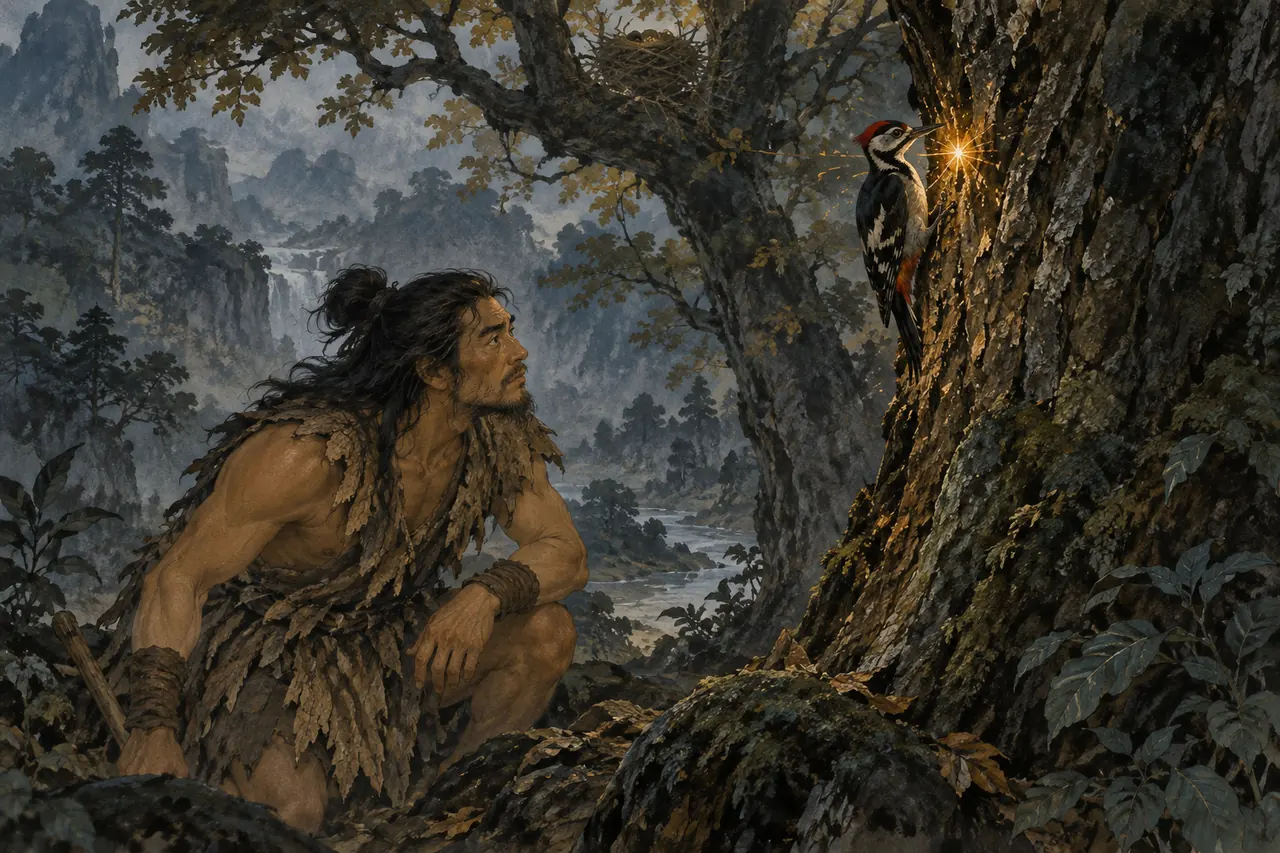
After Youchao’s death, Suiren lives on the summit of Mount Buzhou, in a place called Yicheng, where sunlight does not reach and the seasons and the division between day and night are unclear. Journeying south, he sees a large tree and a bird now called a woodpecker striking the trunk with its pointed beak. At the point of impact, fire appears.
Suiren watches, thinks about the south as the direction associated with fire, and studies the celestial heart. He understands that fire can be brought out of wood. He teaches people to drill wood for fire, following the bird’s action. Different woods suit different seasons: green elm and willow for spring, red jujube and apricot for summer, yellow mulberry and cudrania for late summer, white oak and related woods for autumn, dark locust and sandalwood for winter.
The detail matters. Fire is not presented as a generic technological breakthrough. It is embedded in a seasonal world. Different woods belong to different colors, directions, and times of year. The lesson is not simply “how to make a flame.” It is how to do so in accordance with a patterned cosmos.
Suiren then teaches cooking. Wood is burned; animal flesh is roasted; millet and suckling pig are prepared with heat. Cooked meat tastes better than raw meat, and people are said to suffer less from the foulness and disease associated with raw food. Fewer die; the population grows. In winter, people store fuel and burn it for warmth. Metal is cast and earth is shaped into vessels. Fish, turtles, soft-shelled turtles, and crocodile-like creatures are caught from deep waters and cooked.
More reliable food means more people. New tools and containers make daily life richer. Yet people who had eaten blood food are said to have had shallow desire; once they have fire food, desire burns more fiercely. Fire warms, feeds, and preserves life. It also intensifies appetite.
How a knot, a school, and a market changed a village
As the world of food and exchange grows more complicated, memory becomes a problem. Neighbors share animals and fish; some borrow food; disputes follow because there is no proof of what was given or owed. Suiren tells people to tie a large knot in a rope for a large matter and a small knot for a small matter. When the obligation is settled, the knot can be untied. The practice gives people something to point to when words fail.
The knot is a modest invention with serious consequences. It appears because trust can no longer settle every disagreement. The more people borrow, exchange, and argue, the more they need a record that outlasts a conversation.
Suiren also selects people who understand the great principles and establishes a platform for teaching, like a school or lecture hall. People who do not understand a matter can ask a teacher. With instruction, the population becomes more capable and is said to grow more intelligent. Four assistants are appointed to aid Suiren in ordering things. Seasonal signs, measurements, birds, beasts, insects, and objects receive names. Goods acquire prices; people can recognize and discuss what they encounter.
At midday, a market is established. People gather, exchange one thing for another, set values, and move resources through the realm. Those who once fed themselves wherever they happened to be now have prices, goods, exchanges, and a common meeting place. People become well supplied and, gradually, more honest and pure again.
Trade moves resources to where they are needed. The desires and conflicts it can awaken still have to be managed. An intelligible, fair exchange lets people meet needs without turning every bargain into a fight.
When children learned who their fathers were
With cooked food, people’s desires are said to become more intense. Men seize attractive women without regard for who sees them; sexual pleasure is pursued to excess; bodies weaken and illness follows. Suiren responds with a rule: a man at thirty may take one woman as a wife, and a woman at twenty may marry one man as a husband. They eat together by day and sleep together by night.
Marriage is offered as a remedy for disorder and bodily depletion. Children now know their fathers. Fathers begin to love their children; children begin to show filial feeling toward fathers. Suiren then tells people that each generation can use a name as a surname, that names should differ, and that distinctions can be made.
Now men and women are expected to marry at set ages, and a child’s father has a name. That changes more than family introductions. People start talking about a ruler and his ministers, parents and children, elders and younger people, husbands and wives. Each relationship comes with an expectation about how people should treat one another.
Earlier, people moved freely and children knew their mothers but not their fathers. The new family rules make some things clearer, but they also narrow a way of life that had left people more room to come and go.
Cangjie puts names on the world
Several rulers follow, and then Cangjie appears, a man of extraordinary intelligence with a dragon-like face and four bright eyes. At Mount Yangxu, beside the waters of Xuanyi, he receives a book from a sacred turtle with red armour and blue markings. He studies the curve of the Kui constellation, the turtle’s patterns, bird feathers, mountains, rivers, palms, and fingers. The world is full of forms, he says, but without names and signs people point vaguely and leave nothing that can be passed on.
His solution is to make characters from the patterns of heaven and earth, mountains and birds. Things acquire names. Above all is the ruler; beneath him are ministers; the countless multitude becomes the common people. The one who gives birth to me is father; the one I give birth to is son. With these distinctions come teaching, ritual and music, law, punishment, and offices.
Grain falls from heaven like rain, ghosts cry at night, and dragons hide when Cangjie invents writing. Once people can draw a thing’s name, it is harder for it to vanish from memory. Writing does more than keep a record: it gives people a way to point to things they cannot see.
Characters do more than label animals and rivers. They make ruler, minister, father, son, and commoner explicit. Knowledge can now be passed between generations, but the world also becomes more sharply divided. Every gain in order carries new constraints.
An early ruler named Lilu shows what happens when authority refuses the restraints it asks of others. He burdens the people with labour and ignores his officials’ objections. His minister Donglizi speaks against the cruelty and warns him not to govern by his own stubborn will. Lilu kills him. The news travels through the population, whose anger turns to rebellion. Lilu calls for soldiers, but they too resent the murder; no rescuing force arrives, and the people kill him. The offices Cangjie named and the rules others taught cannot save a ruler who silences honest counsel. A title can mark authority, but conduct has to sustain it.
Elsewhere a figure called Xuanyuan watches loose leaves twist and roll in a strong wind. Their circular movement gives him the idea for two wooden wheels. He places a seat above them and adds the horizontal *xuan* and the straight *yuan* that give the vehicle its name. The first impulse comes from a leaf; the finished carriage makes travel easier for someone seated above the wheels. He reserves that seat for people of rank, excluding commoners. Here too an invention solves one problem while making a social difference more visible. A wheel can carry a body across the ground; the rule about who may ride determines whose body it carries.
Xuanyuan then studies where routes are open and where they are blocked, arranging broad roads through the four directions. He finds mountains that yield copper and iron, teaches people to smelt them with fire, and makes coin and knife money for exchanging goods. The vehicle, road, furnace, and currency form a chain. A person can travel farther, bring a good to another place, and measure its value there. The windblown leaf has led far beyond the moment in which it first caught his eye.
The dove whose song became music
Zhurong walks among dense trees and hears a dove calling with a natural rhythm. He listens closely and finds in its voice a source for song. Following the bird’s high and low tones, clear and rough sounds, he makes music. Birds gather and sing in harmony. Music is said to communicate among kinds, harmonize spirits, and bring human voices into accord. People who hear it become clearer in sight and hearing, more even in their blood and breath, less coarse and impulsive, and longer-lived.
The dove’s call becomes more than an attractive melody. Its pattern moves through the body and the social world at once, bringing people, animals, spirits, weather, and human temperament into better relation. Sound is treated as something that can change how people live together.
Other rulers use music to make a gathering possible. Under Getian, eight men hold parts of an animal and sing in eight sections, while others strike clay vessels and dance. People trade money, silk, gold, and jade across regions; places that had been stagnant open to traffic. Song, movement, and exchange fill the public space together. No great command is needed for every transaction when people have learned how to meet, listen, and trust.
Later, when prolonged clouds, wind, and illness afflict the world under Zhu Xiang, music is again used as a response. A five-stringed zither is made to counter an excess of yin and restore balance. Under Yin Kang, blocked water and stagnant bodies are addressed through movement: people swing their arms, kick their legs, turn, squat, and practice with staffs until sweat comes and swollen limbs recover. The exercise becomes the Great Dance.
Between these scenes stands another Youchao, a later ruler who bears the same name as the builder of tree nests. The earlier nests had lifted people away from dangerous animals, but life high in the branches exposed them to wind and falls. The later Youchao shows them how to weave wood into houses and gather grass for doors. They can remain on the ground and still keep out weather. An old solution has become a source of danger; a new shelter answers it.
Zhu Xiang’s crisis also begins with a disturbance in the air. Dark clouds linger, strong winds spoil fruit and plants, and summer feels like a season without sunlight. People suffer alternating fever and chills. Remembering Zhurong’s music, Zhu Xiang has a five string se made to release the blocked relation of yin and yang. Its notes are played and the heavy clouds begin to part. Under Yin Kang the obstruction is in the waterways and, in turn, in the people’s limbs. His advice is physical: swing fists, kick, turn, squat, and move with a staff. The people sweat, tire, rest, and return the next day. Their Great Dance names a repeated practice, not a single cure performed by a ruler.
Birdsong becomes music; music becomes a means of social and bodily harmony; movement becomes medicine. The makers of this early world move between fields of work. They solve problems by listening, watching, naming, making, and teaching.
Every fix changes something else
People can now live in nests and then houses; they cook with fire; they make metal tools and earthen vessels; they record obligations with knots; they teach and trade; they marry, take surnames, write, sing, travel on roads, and use money. Each new practice gives them another way to learn from the world around them.
The first violence and the first quarrel remain close at hand. More food becomes appetite; skins become objects of rivalry; a name clarifies a relation and fixes a rank; writing preserves knowledge and makes the world answerable to classification. These arts keep people alive. They also make people more capable of wanting, competing, and ruling.
None of the makers can foresee every consequence. Youchao builds a refuge in the trees, and another Youchao later has to bring people back to the ground. Suiren lets them cook, then has to answer changes in appetite and desire. The inventions endure because later people keep revising them, meeting new troubles with the materials and knowledge now at hand.
Each invention comes out of a scene: a body in danger, a bird striking wood, a borrowed meal, a child without a named father, a turtle bearing a book, a dove singing in the trees, a person unable to move because water and breath have stagnated. Practical answers become lasting customs. The emergency passes, but the habits remain.
A tree nest changes where a person sleeps; it also changes the relation between people and animals. A knot records a debt; it also admits that memory and goodwill are no longer enough. A character names a thing; it also makes that thing available to law, ceremony, rank, and inheritance. Human ingenuity improves the chances of survival while reshaping the lives it saves.
Its people do not leave the natural world behind. Chenfang takes bark from trees; Suiren learns from a woodpecker; Cangjie studies a turtle; Zhurong listens to a dove. Each sees something already happening and makes a lesson that can travel. The most valuable part of the gift is that other people can make it again.
*Reference: 盘古至唐虞传, Chapters 2–3, in the supplied modern-Chinese edition.*