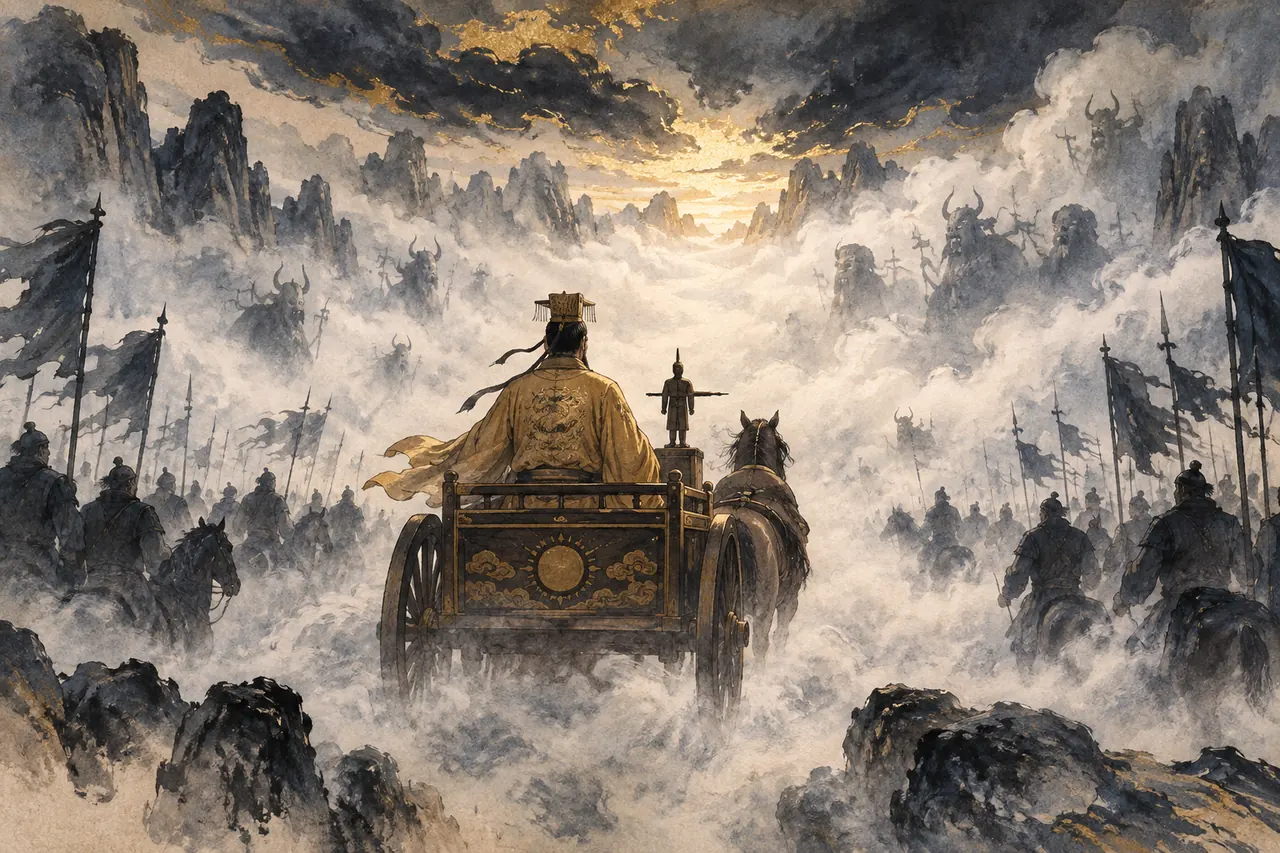
At Zhuolu, a soldier loses sight of the man standing beside him. Chiyou has called up cloud, wind, rain, and a mist so thick the allied troops cannot recognize one another. Xuanyuan, the lord who will become the Yellow Emperor, pulls them back. He cannot win a battle if his army cannot tell friend from enemy.
Long before this war, Shennong had taught people to watch the seasons, break the soil with wooden tools, plant grain, and test the plants that might heal them. He made a market where one household could trade what it had for what another lacked. Chiyou comes from the line of those early rulers. What he does with power would have horrified the man who gave people a plough.
The route from Shennong’s fields to Chiyou’s battlefield runs through a failing court. Yuwang issues orders too quickly and loves the sound of his own cleverness. Chiyou drills soldiers, builds crossbows, and makes other lords yield out of fear. Xuanyuan will need more than bravery to stop him. He will need people who can find a way through the fog.
For the people between these rulers, the stakes are simple. Someone has to grow the next crop, treat the sick, carry goods to market, and make it home from war. The battle at Zhuolu will decide who rules them. It will also show whether the new ruler can keep those ordinary tasks possible.
Shennong teaches people to grow their own food
Shennong is born to Shaodian and Andeng after a wonder connected with a divine dragon. He is said to have an ox’s head and a human body, and takes the surname Jiang. He builds his base on Mount Lie and is known as Lieshan; his domains at Yi and Qi give him the name Yiqi. He rules through fire virtue and establishes first one capital and then another. He bears the title Huangdi here; Xuanyuan, who comes later, is another ruler.
Before Shennong’s instruction, people roam hills and wild ground, eating gathered plants and fruit and the flesh of animals they have fought. They do not know cultivation. Their way of eating is precarious. Food is found, then eaten; they cannot yet prepare the next season’s supply.
Shennong first reads the sky and then the land. The sky has four seasonal movements: things are born in spring, grow in summer, bear fruit in autumn, and fall away in winter. The ground is uneven—high and low, plains and wet places—and different ground is fit for different grains. At the proper spring moment he identifies where grain should be planted and teaches the people to farm it.
The tools matter. Hard soil cannot simply receive seed. Shennong tells people to sharpen wood into a *si*, a digging implement, and to bend wood for the handle of a *lei*, a plough. Only then do they learn to cultivate the five grains. The sequence is spare but exact: observe seasonal time, distinguish land, alter a material into a tool, and make planting possible. Agriculture is neither an accidental discovery nor an abstract emblem of progress. It is a body of judgments carried into daily labour.
His proclamation is built around dependence. “The people are the foundation of the state; food is heaven to the people,” he says. If one person does not cultivate, someone under heaven will suffer hunger; if one woman does not weave, someone will suffer cold. Men must work the fields; women must raise silkworms and spin, so that there may be food and clothing.
The work is divided: men plough, women weave. If one side stops, the whole household feels it. Shennong’s rule starts with the basics people need to live. They take farming and their livelihoods seriously, the weather cooperates, and by the twelfth month they gather what the year has produced and offer thanks in the *la* ceremony.
The red whip follows this ritual. Shennong strikes the plants “into sprouting” at the edge of seasonal renewal. He is standing in a world whose seasons, soil, tools, and work must be coordinated. The gesture joins ceremony to the material rhythm on which people eat.
The emperor who risked poisoning himself
The next scene begins with a sick person who cannot eat. Shennong wonders why grain, usually nourishing, no longer helps when the body is burning with fever or chilled by cold. He starts tasting plants, looking for something that might bring relief. Some herbs warm the body, some cool it, and others help with different troubles. The search is risky: he is learning by putting each plant to the test on himself.
He tastes a hundred grasses day after day to learn those qualities. Before he reaches the plants, twelve poison spirits discuss what he will do. If Shennong identifies their poisons, people will know their names and natures. The spirits decide to join their effects together in one day, hoping to overwhelm him.
He suffers. His intestines churn and his belly hurts. But he takes plants with antidotal power and the poison is dissolved. He makes a book of prescriptions: this poison is countered by this medicine; this illness is treated by that remedy. Sick people take them and recover at once, and more people come to understand healing. The twelve poison spirits, seeing that their names and harmful properties have been recorded, retreat to deep mountains. That is why poisonous drugs are said to grow there.
Shennong comes out of the ordeal with a record. He writes which plants made him ill, which ones relieved him, and what people might take when sickness comes. The poison spirits retreat into the mountains because he has learned their names and told other people. His pain has produced something they can use without meeting those spirits themselves. In the story, the healer’s most generous act is sharing what he found.
Springs may be sweet or bitter. Sweet water is clear and without poison; bitter water is turbid and harmful. Shennong tells people to avoid bitter water and drink where a sweet spring can be reached. A ruler famous for a birth linked to a dragon and extraordinary medicine also tells people which water is safe.
People live securely, eat the results of their own farming, and treat sickness. Then Shennong lays out shops within the state and teaches them to hold a market at noon. People bring whatever goods they have; wares are arranged in stalls; what one person has is exchanged for what another lacks. Everyone leaves satisfied.
At noon, the market fills. One family brings what it has grown or made; another brings something the first family lacks. By the end, both can leave with what they need. The scene is far from the dark field at Zhuolu. Shennong’s people can see one another across the stalls. They have reason to meet as neighbours, not as enemies waiting for an ambush.
The ruler who would not punish a rebel
Fire appears as an auspicious sign, and Shennong names officials through fire: Great Fire in spring, Quail Fire in summer, Western Fire in autumn, Northern Fire in winter, and Central Fire at the centre. Then the lord Sushashi rebels and refuses Shennong’s commands.
Jiwen, a minister of Sushashi, warns his own lord. Shennong is emperor, he says, yet he still feeds himself by labour and makes medicines to save the people. Such a ruler is not without virtue; rebellion will bring guilt. Sushashi answers by killing Jiwen.
When Shennong’s officials urge a punitive campaign, their case is straightforward. The rebel has not only defied his ruler but murdered a remonstrating minister. Shennong does not deny the offence. He answers differently: the rebellion proves that he, as ruler, has not been virtuous enough. He will cultivate his virtue more diligently.
Sushashi has committed a serious crime, but Shennong still refuses to send an army. The people of Sushashi can see the difference between the two rulers: Shennong treats them fairly; their own lord grows cruel. When the people finally rise against Sushashi, his soldiers do not defend him. The ruler is killed, and his followers go back to Shennong.
Sushashi treats warning as an injury to his power and kills the speaker. Shennong treats rebellion as evidence that should expose his own deficiency. One ruler isolates himself; the other becomes the point around which allegiance gathers. Sushashi’s people withdraw the support that his violence had presumed. The resolution still costs a life.
States across the nine regions hear of Shennong’s virtue; locations south, north, east, and west mark the extent of their submission. He rules for 140 years and dies at Chaling in Changsha, remembered as the Flame Emperor.
Good rule pays attention to seasons, land, illness, water, exchange, and remonstrance. Kindness alone cannot plough a field or cure a fever. Shennong makes durable arrangements and accepts responsibility for the conditions in which people live.
Yuwang gives orders nobody can carry out
Eight generations later, the throne reaches Yuwang at Kongsang. His problem is not that he lacks energy. He is too quick. Every order is issued with immediate compliance in mind, without regard for whether it can actually be carried out. When he handles policy with the other lords, he insists on showing his own cleverness and being faster than everyone else, whether the affair succeeds or fails. He praises his own methods and acts as he pleases.
Shennong had looked at the seasons, the ground, and the tool before telling people to plant. Yuwang barely pauses to ask whether an order can be done. Lords begin to talk about rebellion. One of them knows exactly how to turn their anger into an army.
Among them is Chiyou, also of the Jiang lineage and a descendant of the Flame Emperor. He loves military affairs. He asks the lords why they should honour Yuwang, whose virtue is too slight for superiority, when their own strength and intelligence are no lower. They agree and disperse. Chiyou then makes rebellion concrete.
He teaches soldiers to manufacture great battle crossbows and drills them outside the settled space. The poem that follows inventories the equipment with relish: bamboo helmets, rhinoceros-hide armour, swords and blades with thunderous or frosted names, hand crossbows, great bows that can pierce willow at a hundred paces, axes, halberds, stones, and arrows. The men are strong and daring; bodies are struck and pierced.
Chiyou sees his armed men and is delighted. He attacks eastern lords one day and western states the next. Other lords yield in fear, which makes him bolder. Yuwang tries to contain him by giving him authority over the western lords. Chiyou takes the concession as proof that Yuwang is afraid. Now he wants the imperial throne itself.
Yuwang does not fight. He quietly moves his capital to Zhuolu and leaves Kongsang to Chiyou. The withdrawal is not celebrated. It confirms how far the earlier political order has thinned. Where Shennong had turned rebellion back on an unjust local lord through conduct, Yuwang’s hurried, self-regarding rule has made room for a man who understands only intimidation.
Chiyou makes the battlefield disappear
Xuanyuan, the future Yellow Emperor, is a feudal lord named Gongsun, son of the ruler of Youxi. His mother Baofu sees a great electric light circling the pivot star of the Northern Dipper, conceives, and bears him after twenty-four months on Xuanyuan Hill. He has the sun’s prominence at his brow, a dragon-like face, and signs of auspicious stars and clouds. He grows up quickly in moral perception and intelligence, lives by the Ji River, and takes Ji as his surname.
Xuanyuan uses arms against lords who refuse to appear at court, and they come to serve him. When he sees Chiyou’s open wickedness, he calls together the troops of the various lords and marches to confront him at the wilds of Zhuolu.
Chiyou laughs at the assembled force. Bareheaded and loose-haired, he walks ritual paces and performs magic. With a sword and a sleeve he brings dense clouds; mountains darken, the red sun is obscured, black vapour rises, and a day becomes like midnight. He summons a great mist, calls the Wind Master and Rain Master, and unleashes wind and rain. The allied soldiers cannot recognize one another face to face. Their clothes are soaked. Xuanyuan cannot advance and withdraws them.
Xuanyuan recognizes that the immediate conditions make battle impossible. Chiyou is delighted and returns to camp after dismissing the mist. Xuanyuan needs a way for his soldiers to find direction again. In the night he dreams.
In the first dream, a great wind sweeps the grime of the world away. In the second, a person holds a thousand-*jun* crossbow and drives countless sheep. Xuanyuan unpacks the images as names. Wind suggests the person who gives commands; after dirt is gone comes *hou*, “behind.” Is there someone surnamed Feng and named Hou? The enormous crossbow suggests unusual strength; the herding of many sheep suggests a person able to guide people toward good. Is there someone named Limu?
He sends searchers in every direction for the people indicated by the dreams. Fenghou is living in retirement by the sea, able to arrange heaven and earth and devise mechanisms beyond the measure of ghosts and spirits. The searchers hear him walking and chanting of the misfortune of meeting Chiyou, the hardship of soldiers, and the need for a saving sage to use what he holds. They approach him by asking whether he knows a man called Fenghou. He asks why they seek him; when they describe Xuanyuan’s dream and invitation, he says that he is Fenghou.
He also knows Limu, his friend, who lives in a few households by a great marsh. The journey to Limu’s thatched dwelling is deliberately humble after all the celestial omens. A grey-headed servant appears singing a difficult line; Fenghou asks the visitors what they make of the man’s voice, and they hear the mouth of an ambitious hero. Limu emerges, hears the account, says that by his reading of the sky Chiyou is due to perish, and joins the journey.
Xuanyuan has enough standing to summon lords, yet he seeks knowledge he does not possess. Fenghou brings the *woji* eight-gate formation; Limu explains methods of encampment, movement, advance, and retreat. Xuanyuan appoints the first as minister and the second as general. Yuwang had displayed his own quickness; Xuanyuan gives real authority to those he finds.
How a carriage helped an army find its way
At Zhuolu, Fenghou lays out the array: forward and rear units of heaven and earth, wind and cloud units, tiger wings, coiling serpent, flying dragon, soaring bird, and wandering troops. Four are called regular and four irregular. The surplus becomes the grasping surprise force. The movements follow celestial signs, weather, the lay of mountains and rivers, and the advantages or dangers of facing one direction rather than another. The principle is to meet with the regular and overcome with the unexpected.
Every unit must know its relation to terrain, climate, time, and signals. Xuanyuan understands the formation at once and tells the lords that Chiyou will surely be captured. They marvel, and the army advances.
Chiyou repeats his answer: mist, Wind Master, Rain Master, hard weather, and obscurity. This time Xuanyuan has asked the celestial maiden Ba to come. Wind and rain stop. He has also made a south-pointing carriage so that the troops can know east, west, south, and north and will not be confused by the mist. Five-coloured cloud-energy appears above him; the smoke cannot come near, and Chiyou’s army is alarmed.
Chiyou turns direction into a weapon by removing it. Xuanyuan restores direction with a south-pointing carriage that allows ordinary soldiers to know where they are. It belongs beside Shennong’s agricultural tools and medical prescriptions. A ruler’s intelligence appears in devices that make action possible for others.
Chiyou, enraged that Xuanyuan’s forces are neither disoriented nor soaked, charges into the eight-gate formation. Fenghou signals in the four directions, and the array changes: the forward heaven-and-earth force becomes tiger wings; wind coils like a serpent; the rear becomes a flying dragon; cloud attacks like a bird. The enemy is turned round and round within the formation. Chiyou breaks left and right, kills and charges, but cannot escape. In his rage he rushes toward the centre, encounters a wandering unit led by Yinglong, and falls from his horse amid what seems to him a confusion of dragons, snakes, and birds. He is taken.
Xuanyuan executes him at Mount Song in central Ji. Chiyou’s blood flies into a great pool and changes its water to brine, which forms salt in the heat of the sixth month. The fetters discarded on Mount Song become maple trees. His defeated body leaves marks in the landscape. Violence has an afterlife.
The lords return to Xuanyuan. He becomes Son of Heaven in place of Shennong, then defeats Yuwang in a later battle and grants him a reduced domain at Luo. The Shennong line ends.
What the victors will inherit
Chiyou dies at Mount Song. Yuwang loses his claim, and Xuanyuan becomes Son of Heaven. The soldiers can finally see one another without mist between them. On the way home, they will pass fields that still need planting and villages where people still get sick. A victory cannot do that work for them.
Shennong had shown a ruler how to feed and heal people. He even refused to attack Sushashi after the rebel killed the one adviser brave enough to warn him. Yuwang forgets to listen before he commands; Chiyou learns that frightened lords can be made to kneel. Xuanyuan survives his first defeat because he admits he needs help. He finds Fenghou and Limu, gives them real authority, and sends his troops back with a formation and a south-pointing carriage.
The carriage is a small thing beside Chiyou’s storm. Its needle keeps pointing south while the sky disappears. A soldier can look at it, turn, and find his place in the array. That is the kind of victory Xuanyuan can build on: a way for people to know where they are and what to do next.
Shennong once carried a red whip among growing plants after the harvest rite. Fenghou now raises banners that make an army turn together in the mist. Their tools belong to different times and different needs. Xuanyuan has won the war; the next test begins when the banners are put away and someone asks him where the road, the market, and the medicine will come from.
*Reference: 盘古至唐虞传, Chapter 5, “神农黄帝氏立极 风后八阵困蚩尤,” in the supplied modern-Chinese edition.*