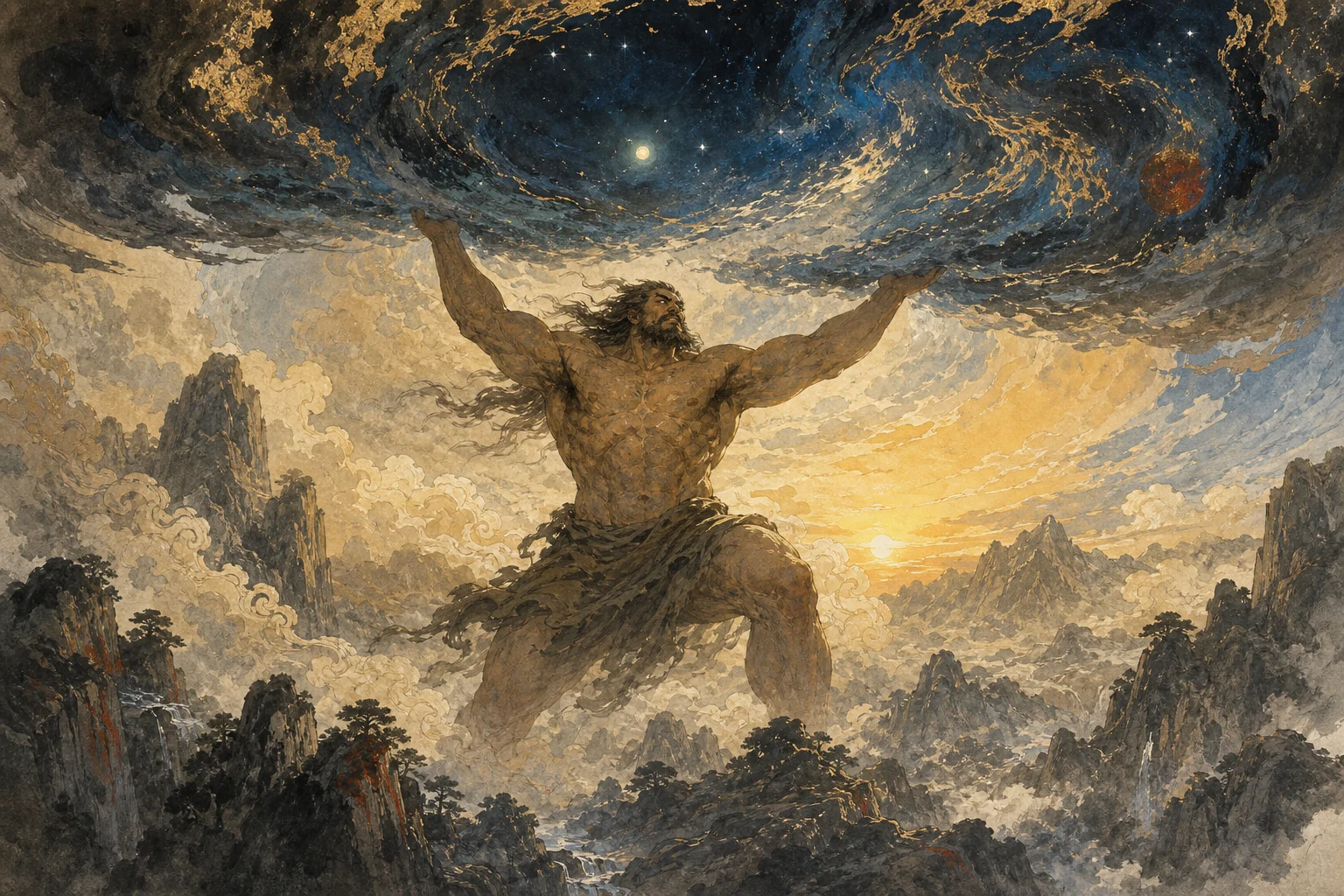
At the beginning, many later tellings say, heaven and earth were mixed together in a formless state like an egg. Within it Pangu slept and grew. When he woke, he broke the enclosure apart: the light and clear rose to become the sky, while the heavy and turbid settled into the earth.
Pangu stood between the two realms so they could not collapse back into one another. Each day the sky rose higher, the earth thickened, and Pangu grew with them. After an immense span of time, the world had become stable enough to endure without his support.
A body becomes a landscape
The most memorable part of the story is its transformation. Pangu's breath becomes wind and cloud; his voice becomes thunder; his eyes become the sun and moon. His limbs turn into mountains, his blood into rivers, and his hair into stars and vegetation. The cosmos is not merely built around him—it is made continuous with his body.
This image gives the myth an ecological force. Mountain, weather, water, and living things share a common origin. The world is ordered through separation, yet everything within it remains related.
One beginning among many
Pangu is not the only Chinese account of beginnings, and the familiar narrative was assembled and expanded across different texts and periods. It is best read as one influential strand in a much larger field of regional traditions, philosophical cosmologies, and stories about culture-bringers. Its lasting power lies less in a single fixed version than in the unforgettable idea that creation is an act of growth and transformation.