The light behind the stone
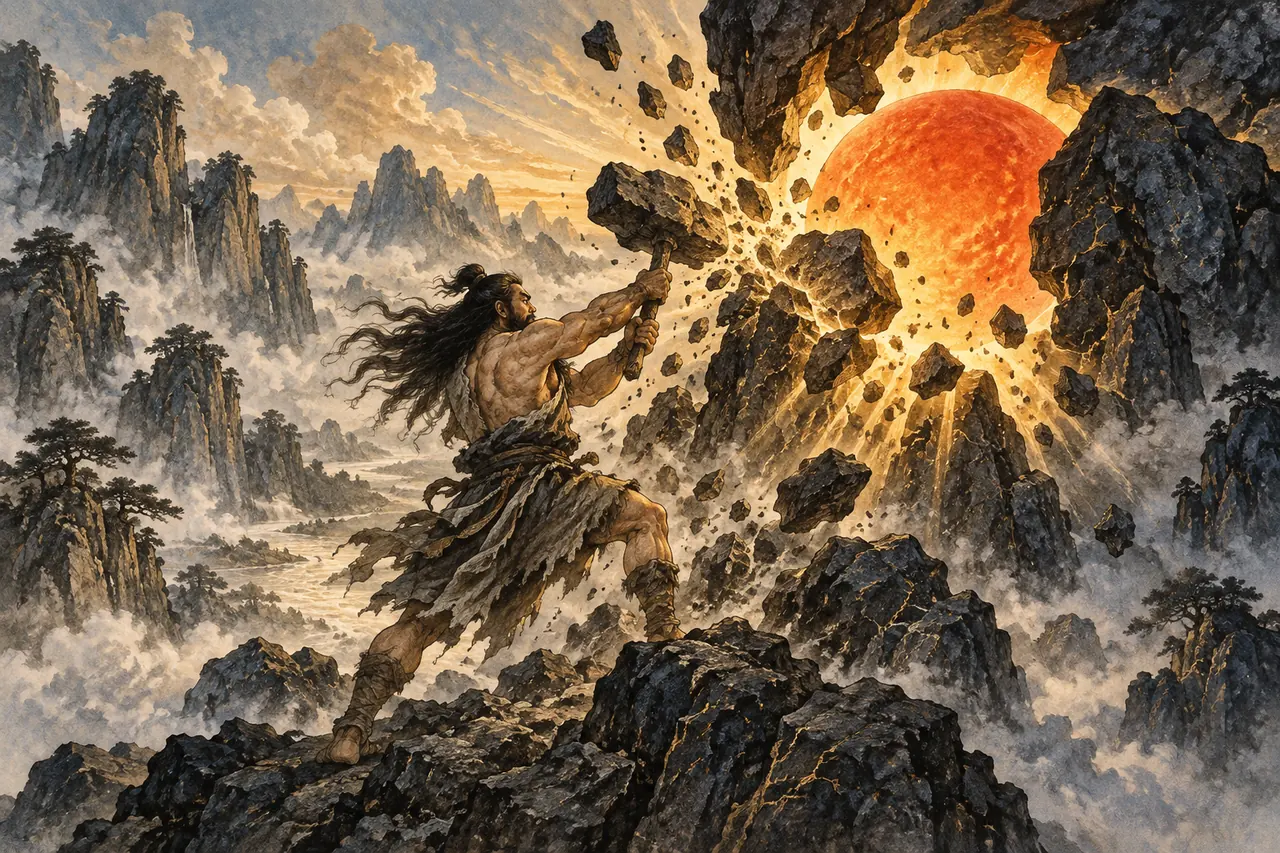
Imagine finding the sun trapped inside a mountain. That is what Pangu sees after he has forced heaven and earth apart. The world has begun to take shape, but its light is still locked away. Pangu picks up his tools and goes to work again.
Several hundred years have passed since the first split. The sky stands above the earth, yet the sun still does not shine where it should. Light presses through the rocks of an eastern mountain. Pangu recognizes what is inside, finds a way to break the barrier, and releases a red sun as large as the mountain itself. In its light he finds a palace and the being who dwells there.
The task began long before that meeting. Heaven and earth were once stuck together, with the light and heavy parts of the world unable to find their places. Pangu had to strike them apart. The sun hidden in stone is the next obstacle. After Pangu, rulers will inherit a world still full of blocked paths, unfinished shelters, and people who cannot yet count a year.
Heaven and earth refuse to come apart
Heaven and earth are mixed together in a state called *hundun*, before distinctions have become visible. Time itself moves through immense cycles. A *yuan* is divided into twelve assemblies, linked to the twelve earthly branches. Heaven emerges in one phase, earth in another, human beings in another. Eventually the world declines and dissolves, and the cycle begins again.
The cycle runs for spans so vast that a human reign looks brief beside it. Heaven appears, earth follows, people enter, and eventually the world wears down toward another darkness. Pangu arrives at one of the moments when things can open again. He has a chance to act before what is forming hardens into a world where light cannot pass.
Pangu appears when heaven and earth are not fully divided. Some of the light and pure substance has risen; some of the heavy and turbid substance has sunk. But there are places where they remain stuck together. Pangu recognizes that this adhesion blocks the movement of yin and yang. He looks for a sufficiently hard tool and finds a sharp stone formed from the essence of the western metal. He then searches for a hammer-like implement to strike it. With these tools he breaks open the places where heaven and earth remain joined. Heaven rises; earth falls. The two primary forces take shape as yin and yang begin to separate.
The sharp stone matters because the world does not yield to a wish. Pangu has to search for a tool hard enough to cut through what holds heaven and earth together, then find something with which to strike it. The gap opens under the blows. What is light can rise; what is heavy can settle. At last heaven and earth have room between them.
A world can still get stuck
Pangu can step back from the gap he has made, but he cannot assume the work is finished. The sun remains sealed in the mountain. Elsewhere the future course of the moon is hidden too. The first act of creation has given them space; it has not yet given the earth a morning.
In the world Pangu is opening, yin and yang need to move in relation to one another. Cold must give way to warmth and warmth must return to cold. Wind and rain must come, but neither can stay forever. A sun that cannot rise is more than a missing lamp: without its journey there can be no ordinary succession of days.
He turns east toward the light in the rock. The work waiting there is familiar in one respect. Something that ought to move has been held fast. Pangu finds the obstruction and prepares to break it.
The sun inside the mountain
Several hundred years pass after heaven and earth separate before the sun appears. Pangu sees a mountain in the east whose rocks and vegetation obstruct a great radiance within. He recognizes the light as the essence of the sun and breaks open the rocky barrier. A red sun emerges, as large as a mountain. Inside it is a celestial palace, where the Sunlight Bodhisattva greets him.
The moon appears through a parallel scene. Pangu sees another mountain, opposite the place of sunrise, from which a weaker but still immense light shines. He recognizes the essence of the moon, opens the rock, and reveals the moon and its palace. The Moonlight Bodhisattva greets him in turn. The moon’s palace, because it belongs to the softer yin side, requires repair. Pangu orders its inhabitants to work on it with tools.
The sun and moon have places, palaces, inhabitants, and material problems. Their courses also give time a geography: the sun rises from Fusang in the east and enters Xiliu in the west; the moon rises in the east and sets in the west. Their extraordinary dwellings belong to a dependable movement that people will see again every day and night.
The moon’s palace needs work after its light is freed. Pangu orders those who live there to mend it with tools. Its softer yin nature requires attention. Day and night can now alternate, but someone must still repair the dwelling from which the moon will make its journey. Even a celestial home has a roof that needs tending.
Pangu’s two journeys to the hidden lights also give the horizon a new shape. East is where radiance emerges; west is where it passes from view. People on the ground cannot enter either palace, but they can watch the paths repeat. A mythic encounter in the mountains becomes an everyday way to know morning from evening.
Pangu releases the sun and moon from obstruction and establishes their visible course. Their light existed before people could see it. The barrier had to be broken for that light to reach the world.
Stars, storms, and the first weather report
As the sea gradually clears, stars appear in water and sky, shining like strings of pearls and linked jade disks. The Northern Dipper, the South Pole Old Man Star, the twenty-eight lunar mansions, the thirty-six celestial spirits, and countless other lights take their places. A person can now look upward and see an arrangement where once there was only confusion.
Wind, rain, clouds, frost, snow, hail, fog, thunder, and lightning follow. Spring has its gentle wind, summer its warm wind, autumn its metal wind, winter its northern wind. Rains have names tied to Qingming, elm seeds, plums, the fifth month, washed branches, washed carriages, bean blossoms, and yellow birds. Clouds, too, gather at recognizable points in the seasons.
Names make these changes memorable. Wind clears and moves; rain follows the circulation of qi; cold and warmth unfold through the year. A person who knows their sequence can prepare for what comes next. Weather has not ceased to be dangerous, but it is no longer wholly unreadable.
The names reach close to things people can actually see. Plum rain belongs to a recognizable season; bean blossoms and yellow birds help fix another moment in memory. Someone may forget a numbered day more easily than the flowering plant outside a door. By tying wind and rain to such signs, people can speak about weather together even before they can measure it precisely. A pattern becomes useful when it can be recognized by many eyes.
Later rulers will watch these signs instead of making them. They cannot order the stars to return or the plums to flower. They can notice the return and tell others what it means for the season ahead. A person planning to travel or plant needs that much from a ruler more than a speech about the heavens.
Pangu’s body becomes the landscape
When the world has taken shape, the Heavenly Sovereigns appear and Pangu withdraws. His head becomes the four great mountains, his eyes are entrusted to the sun and moon, his fat becomes rivers and seas, and his hair becomes the trees of the mountains. Even his body joins the world he has opened.
Pangu does not remain king of the human world. The Heavenly Sovereigns emerge and begin the next task: making time socially usable. They observe the recurring seasons and create the ten heavenly stems to mark years, beginning with *jia*, *yi*, *bing*, and *ding*. The twelve earthly branches follow. Together, these systems allow people to recognize the return of cold and heat and understand the passage of a year.
The Earthly Sovereigns observe the sun and moon, teach people to distinguish day from night, explain waxing and waning, and establish a thirty-day month. The Human Sovereigns divide the world into nine regions, appoint brothers to govern them, summon wind and rain to relieve hardship, and recognize worthy people as helpers. Rulers and ministers now have distinct responsibilities.
The work moves from cosmos to calendar, territory, and government. People can see what surrounds them, share a way to count time, and rely on someone to respond when a region suffers. Authority grows out of these needs.
The first calendar keeps people on time
The stems, branches, months, and divisions of day and night carry Pangu’s work into ordinary life. People can agree on when a month begins and when a year has turned. A ruler can plan for the season ahead. The cosmic split has become a shared way to count time.
The calendar is not just a set of numbers. Before it, people feel cold give way to heat and heat return to cold, but they cannot easily say where one full cycle ends. Now they can count a year. The Earthly Sovereigns do the same with the moon, marking its changing face as a thirty-day month. People can look up at the same sky and know roughly where they are in the year. That matters when it is time to plant, travel, or gather for a festival. The sky has become a clock everyone can see.
A counted month changes how promises can be made. People can speak of the next return of the moon or the season in which work should be done. The new measure belongs to everyone who can observe its signs. It carries the work of heaven into meetings, journeys, and preparations that require more than one person to agree on a time.
The heavens matter because their patterns guide planting, travel, gathering, and rule. The person who watches the sky can pass that knowledge on to people whose work depends on light and season. Attention to the stars becomes a practical gift.
Creation is only the beginning
Pangu’s departure does not bring the work to an end. The Sovereigns inherit a world with seasons and lights, then ask how people can find their way through it. The answer keeps changing scale: a cycle of heaven, a month, a tract of land, a settlement, a household. Each needs enough order to let people act without knowing everything that lies ahead.
Making a distinction can be an act of care. Day and night, wet and dry ground, the regions of the land, the roles of ruler and helper: these differences let people recognize needs and meet them. Yet distinctions alone do not make a good world. They must leave room for movement, renewal, and the lives they were meant to support.
Pangu’s stone tools, the released sun and moon, the named stars, and the first calendars all belong to that single vision. Creation is not only the origin of things. It is the gradual making of a world in which things have their places, movements, and names.
The sun is especially revealing because Pangu does not keep it for himself. Once freed, it travels across the heavens and shines on every direction. Its motion gives other people a way to mark their own days. The work of opening the sky becomes valuable precisely because its benefit cannot be confined to the one who broke the rock. Each dawn repeats the gift without requiring Pangu to stand there and release the light again.
The same is true of the moon’s course and the seasonal winds. Once their movements can be seen, later sovereigns can observe them independently. They are not asked merely to remember a mighty ancestor; they are asked to keep looking at the world he left them. Their responsibility is renewed by each cycle of cold and warmth. A world made habitable once can still become difficult, and each generation has to learn where its own obstructions lie.
The first communities
The Heavenly, Earthly, and Human Sovereigns carry this work across three levels. The first make the annual cycle recognizable; the second distinguish the lights of sun, moon, and stars and establish the month; the third divide the land and arrange leadership. No one act is sufficient by itself. A bright sky is of little use to a person who cannot find water or a safe place to rest.
People have become more numerous than they were in the earlier ages. The Human Sovereign surveys mountains and rivers, identifies level and difficult land, divides the world into nine areas, and assigns one brother to each area while retaining the central region. He calls wind and rain to relieve people’s hardship and recognizes those with talent and virtue as his wings. Ruler and minister now have distinct roles.
The ruler first sees the shape of the land, then responds to hardship, then chooses capable assistants. Each brother must attend to a region beyond the centre. The arrangement acknowledges that even a gifted ruler cannot watch every river and village himself. He needs other people whose judgment he can trust.
Nine regions also mean nine different journeys away from the centre. One brother may follow a river; another may have to cross dry ground or climb toward a settlement cut into a slope. A division drawn from above becomes useful only when someone can reach the people inside it. The Human Sovereign calls for rain where there is hardship and sends helpers who can act when he is absent. It is a modest end to a tale that began by tearing heaven from earth: a ruler learns how much of the world he cannot hold in his own hands.
People drink clear spring water, gather food, rest together in heat, and endure cold together. They do not yet harm one another through competing claims. A ruler can count them, divide the land, and appoint helpers; he would lose something precious if his new arrangements made these people afraid of one another.
The rulers who came after him
After the Three Sovereigns come the Five Dragons, the Sheti era, the Heluo era, the Liantong era, the Xuming era, and the Xunfei era. Each name marks another attempt to keep the world habitable. The succession is long because no single ruler completes that work for all time.
Some rulers leave little trace; others are linked to a distinct change. In the Five Dragons era, birds, beasts, fish, and insects become abundant. In the Heluo era, people learn to make dwellings by digging into mountain slopes so that wind and rain do not strike them directly. Under the Xunfei sequence, the giant spirit Jùlíng commands the Five Ding men to correct mountains, open difficult routes, and reconnect interrupted waters.
Nature becomes more habitable when obstacles are removed, passages are opened, and forms are placed in workable relation. Pangu separates what is stuck together. The Five Ding men level high places, fill low ones, make roads through dangerous terrain, and connect waters that do not flow continuously. Later makers continue the work of making a world passable and usable.
A family cuts a dwelling into a mountain slope to escape wind and rain. Pangu broke a mountain to free the sun; these people hollow one out so they can sleep inside it. The stone is no longer only an obstacle. In the right place, and cut in the right way, it becomes shelter.
The Five Ding men face rivers that do not meet and high ground that cannot be crossed. Their orders sound immense, almost as if Pangu’s tools have passed into new hands. They lower one obstruction, fill another, and make a route where travel had stopped. A traveller may never know the names of the men who changed the ground. What matters on the day of the journey is that the water now runs and the road can be taken.
The split in heaven leads at last to a cut in a hillside, a road through rough country, and water sent down a clear course. Light can pass. People can travel and live together.
Good rulers know when to leave things alone
There are hierarchies here: rulers and ministers, regions and borders, places near and far from the centre. Their success is measured by whether people can live without needless disturbance. Some early rulers govern quietly, allowing things to complete and transform themselves. Their restraint belongs beside Pangu’s force; both answer what the moment requires.
Pangu’s action is decisive, but it restores the capacity of the world to move according to its own pattern. The early sovereigns give names and measures, yet the seasons still unfold naturally. A capable ruler recognizes those processes and avoids frustrating them.
Heaven and earth must be separated, but their relation keeps changing. Time can be named, but no ruler commands the seasons to recur. Regions can be administered, but authority earns its place by relieving need. Making room for life also means knowing when to leave it alone.
The work left for everyone else
When Pangu is gone, the work continues. The Sovereigns count the months; later rulers make a route through steep ground and give people shelter from storms. They meet smaller obstacles than the rock concealing the sun, but those obstacles can still decide whether a family gets through the season.
The Heavenly Sovereigns give the passing year names. The Earthly Sovereigns make the moon’s changing face countable. The Human Sovereigns send help into regions too far apart for one ruler to watch alone. None can replace Pangu’s first blows; none can live by those blows alone. Their people need a date for a gathering, a way across a river, and someone who will hear when a place is suffering.
The lasting image is Pangu facing a mountain that holds the sun inside it. He does not make light out of nothing. He sees what is trapped, breaks the barrier, and lets it travel. The generations after him will have their own barriers to find. A livable world is made through that repeated act of attention.
Some barriers are immense and visible from the heavens. Others are a flooded path, a wind exposed dwelling, or the inability to say when a season will turn. The work of making the world continues in those smaller places long after the first mountain has been split.
*Reference: 盘古至唐虞传, Chapter 1, “盘古氏开天辟地 定日月星辰风雨,” in the supplied modern-Chinese edition.*