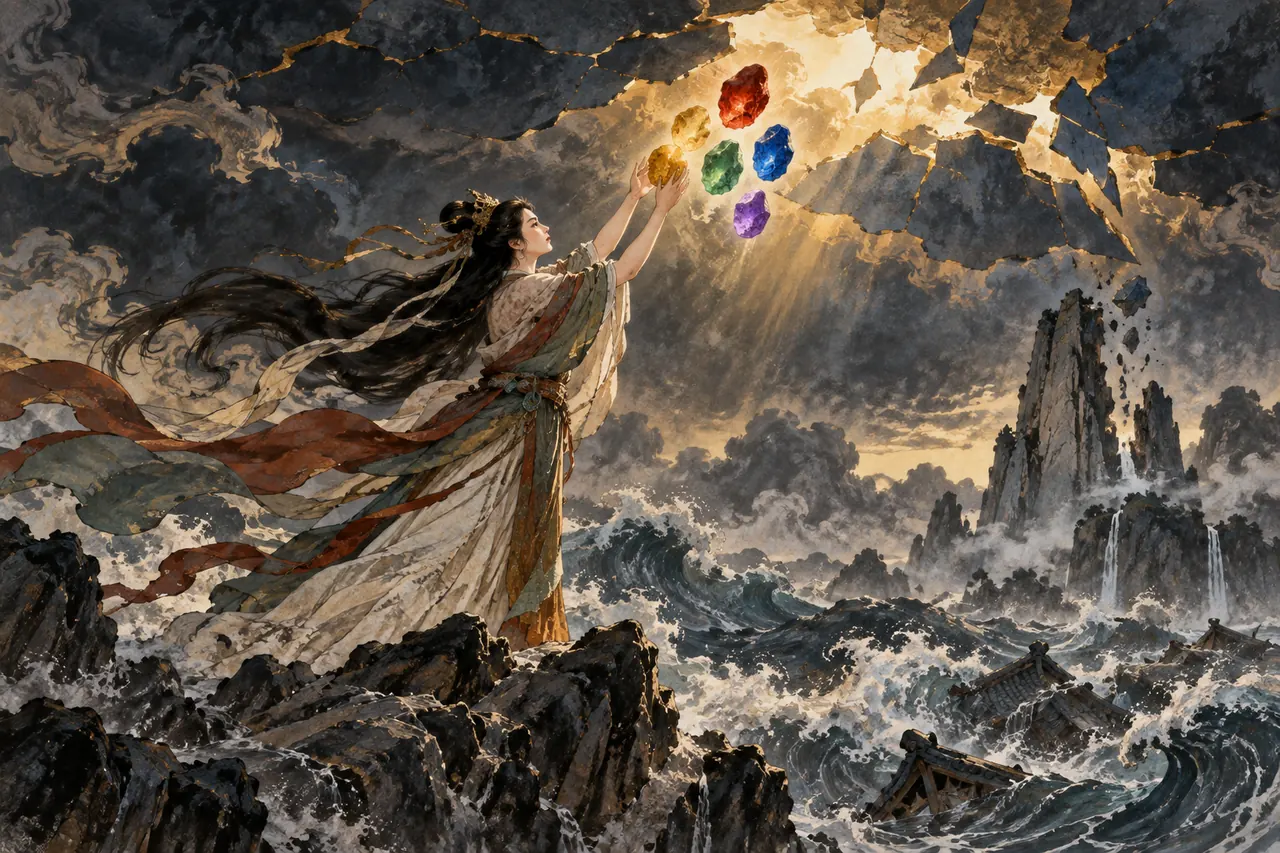
The sky has just fallen in at one corner. Rivers are flooding the land, and the man who caused it is still raging. Nüwa first gathers five coloured stones and repairs heaven. Only then does she go after Gonggong.
To understand why the break matters, go back to Fuxi. He studies stars, rivers, birds, and the marks on a dragon horse. From what he sees he makes signs, calendars, marriage customs, and music. He spends a reign teaching people how to find their bearings. Gonggong needs only a moment of rage to make the sky itself lose its balance.
Nüwa’s answer begins with a choice. Gonggong is still loose, flooding the land, but a broken heaven hangs over everyone. She goes to the mountain first. The fight can wait until the sky holds.
A child of rainbow and river
Fuxi, also known as Taihao, stands first among the Five Emperors. His virtue resembles the brightness of sun and moon, and his place is in the east. His mother, living by the islet of Huaxu, sees the footprint of a giant, feels a stirring of thought, and is encircled by a rainbow. Fuxi is born at Chengji with a serpent’s head and human body. He later rules through the virtue of wood, the first of the Five Phases, and establishes his capital at Wanqiu.
His mother has followed a giant footprint and felt a stirring before the rainbow closes around her. The child she bears has a serpent’s head and a human body. It is an unsettling beginning for a ruler who will spend his life watching the forms of other beings. He seems to belong partly to the world he studies and partly to the people who need him to explain it.
Once on the throne, Fuxi looks in three directions at once. He looks upward at the sun, moon, and stars; downward at mountains, valleys, high ground, low ground, and the forms of the land; and among living things at feathers, fur, creatures that fly, swim, move, or grow. Everywhere he sees yin and yang. He draws one unbroken line for yang and one broken line for yin. From their combinations come the eight trigrams; with three lines doubled, the sixty-four hexagrams emerge.
Fuxi looks at very different things—high and low, light and dark, movement and stillness—and sees ways to set them beside one another. His eight trigrams turn those observations into simple marks people can remember and pass on. The world is still changing, but it no longer looks like a jumble of unrelated events.
Before Fuxi makes a diagram, he watches. The lines come from the world’s marks: stellar curves, river forms, animal coverings, the contrast between heights and hollows. He draws only after he has spent time looking.
A calendar, a compass, and a dragon horse
Fuxi’s next problem is memory. Suiren’s knotted ropes have been useful, but they cannot endure for long. Fuxi teaches people to carve wood and draw signs on it. This is called *huaqi*, marked tallies, and belongs beside the six methods of writing. A mark on wood can carry a matter beyond the life of the person who first witnessed it.
He also creates the *jia* calendar. The earlier Earthly Sovereign had distinguished the three lights and divided day from night through a thirty-day month; Fuxi extends this work. Stems and branches are paired into twelve temporal signs, and six cycles make a full circuit of heaven. Years can be counted without confusion, months do not drift, day and night have measurable divisions, and people no longer lose their bearings in the four directions.
A patterned cosmos helps people avoid being lost. The calendar gives them a common way to say that a year has passed. Directions give them a common way to move. Marks preserve a matter after the person who first witnessed it is gone. The lines of a diagram have become part of ordinary work.
Consider how many forms of absence those marks answer. A person who was present at a decision may leave; the carved sign remains. The moon changes and returns, but memory alone can misplace a month; the calendar gives the community a count it can share. Someone sets off across unfamiliar land and cannot ask the horizon which way is home; a named direction helps. Fuxi’s signs do not remove uncertainty from life. They allow people to carry some knowledge across distance and time.
Even the six methods of writing begin in this practical need for endurance. Knots can record an obligation, but rope frays and a knot says little about the matter to someone who did not tie it. A cut mark and a drawn sign can hold more. The distinction matters to a ruler whose decisions will reach people beyond his immediate presence. What he sees and says must be made recognizable to others after he has gone.
That is also why the River Diagram arrives as it does. On the Meng River, beneath a sky full of cloud and auspicious light, a Dragon Horse rises from the water. It has a horse’s body, dragon scales, a height of eight feet and five inches, wings on its back, and feet that do not sink. On its body it carries the River Diagram. Fuxi recognizes it as the distilled essence of heaven and earth. A secret has been carried out into the open. He then uses the dragon as the basis for a system of offices.
Imagine trying to hold still while such a creature comes up from the water. Its feet do not sink, its scales catch the light, and the marks on its body are suddenly there to be read. Fuxi cannot keep the river from hiding it again. He has to attend to what has appeared while it is before him. Later, when the sky breaks, Nüwa will face a different sight that also cannot be ignored. The two rulers are linked by that instant of recognition: something has changed in the world, and they must decide what to do before the chance passes.
Fuxi does more than marvel at the Dragon Horse. He studies the marks it carries, then uses the dragon as a model for naming offices. What came from a river now guides people who have never seen that river or the creature that rose from it.
Two families, one matchmaker, a pair of skins
Fuxi inherits Suiren’s rule that men marry at thirty and women at twenty, but he decides that it does not go far enough. Men and women, he says, still lack clear distinction. He therefore defines the vocabulary and procedure of marriage. A woman going with her husband is called marrying out; taking a woman as wife is called taking a wife. A mediator must stand between the two houses and settle the match. The ritual uses a pair of skins, because the pair signifies matching. Surnames must be made correct: the surname traces the ancestral line, while the clan name distinguishes branches of descendants.
Now two families have to agree, a go-between helps settle the match, and a pair of animal skins stands for the couple. Surnames and clan names tell people where they come from. Men and women no longer drift together as they once did; marriage has rules, and those rules will shape everyday life as surely as the calendar shapes the year.
People in an earlier age recognized mothers but not fathers. Suiren introduced a household based on a couple and paternal recognition. Fuxi adds mediation, paired gifts, surnames, and formal words. Marriage changes by stages, along with the kind of society in which it takes place.
The mediator is essential. Marriage becomes a public matter involving two households, a third party, gifts, names, and formal words. These elements are meant to prevent confusion and casual harm. A bond becomes durable when others can recognize and witness it.
The pair of skins is a small but expressive object. One skin alone would be a gift; two announce a match. The mediator carries that meaning between households. Names then place the couple within lines of descent and branches of a family. The arrangement gives witnesses a way to remember who has joined whom. It also brings private affection under a public rule, with obligations that neither party can define alone.
Fuxi’s distinction between surname and clan name reaches beyond the wedding day. A surname gathers those who descend from a common ancestor; the clan name distinguishes branches among them. Once those relations can be spoken clearly, a family can remember its past and recognize a more distant member. The same desire for a stable sign appears in the carved tallies and the calendar. Kinship, too, can be lost or confused without a way to mark it.
The qin begins with leaves in the wind
Fuxi’s musical inventions grow out of another act of listening. He decides that Zhurong’s existing musical words do not exhaust their possibilities and creates a form called wild music. He sings of supporting visitors and chants of nets. Then he walks among the mountains to inspect trees. The mountain spirits know he is coming to choose wood for an instrument. They say that the paulownia has the finest voice, and the tree accepts its fate. The spirits raise clear winds; the branches move; the leaves sound.
Fuxi listens closely. Among all the leaves, the sound of the paulownia is the clearest and most subtle. He cuts its wood and makes a qin. The round top models heaven; the flat base models earth; the eight-inch dragon pool reaches toward the eight winds; the four-inch wind pool represents the four seasons; five strings represent the operation of the Five Phases. The instrument is seven feet and two inches long. He twists silk into strings and establishes twenty-seven points, saying that the instrument can communicate the gifts of spirits and bring heaven and humans into harmony. He also makes a thirty-six-string se from mulberry, for the cultivation of self and disposition.
The qin is a miniature cosmos. Its dimensions and parts carry heaven, earth, wind, season, and the Five Phases into an object that can be touched and played. Yet the instrument begins in a sound heard in leaves. A breeze in a tree becomes a model of the world.
Gonggong loses a battle and breaks the sky
Fuxi dies after a reign of 115 years, and Gonggong, named Kanghui, emerges. He has red hair and a powerful body. He trusts his own intelligence, claims the water virtue and the right to appoint offices through it, seizes the region of Ji, and behaves cruelly. Zhurong, who governs another region as Fuxi’s minister, decides that Gonggong must be driven out for the sake of the world.
Their battle is cast as an argument between water and fire. Gonggong boasts of watery force; Zhurong answers that water runs dry in winter. Gonggong taunts the fire official; Zhurong calls him a rebel who lives downstream. The exchange ends in black cloud, frightened animals, red sunlight, and smoke. Gonggong is defeated and runs to Mount Buzhou.
Gonggong strikes the mountain after military defeat. He is ashamed that the people of Ji will laugh at him and no longer obey him. His wounded pride becomes an assault on the world itself. He rams Mount Buzhou with his head.
Mount Buzhou is not merely a convenient mountain. It is one of the pillars bearing heaven, a famed mountain set in the five directions to stabilize the geography of the earth. It reaches to the vital energy of the celestial pivot, regulates yin and yang, and nourishes the many things. Gonggong breaks off one corner. The earth’s sustaining cord is damaged; the heavenly pillar collapses.
A ruler who cannot bear to lose can hurt far more than himself. Gonggong’s anger breaks the sky, and everyone else has to live with the damage. The image is enormous; the cause is painfully familiar.
Gonggong’s title and his claim to water virtue make his next acts particularly bitter. Water ought to nourish and move through the world. Instead, he blocks the hundred rivers and drives their force against the people. Even before Nüwa meets him in battle, he has turned the element he claimed as the basis of his authority into a weapon. His pride bends offices, terrain, and natural movement toward revenge.
Mount Buzhou’s broken corner is a public injury in the largest possible sense. The mountain stabilizes the earth and reaches the vital movement of the heavens. Its collapse cannot be confined to the region of Ji, where Gonggong first feared ridicule. The damage travels outward to people who never fought Zhurong or mocked Gonggong. Private shame has found a way to make strangers pay for it.
Nüwa fixes the sky before settling the score
Nüwa is introduced as the full sister of Taihao. Seeing that Gonggong has failed to defeat Zhurong and has smashed Mount Buzhou, she calls him lawless and says that he has offended heaven and earth. Her first act is not to pursue him. She flies by cloud to the mountain, gathers five-colored stones, refines the qi of the Five Phases, and uses it to remake the body of heaven. Only after the sky is repaired does she turn to the rebel.
Gonggong has made himself impossible to ignore. He is still raging, and now people are living beneath a broken sky. Nüwa does not wait for him to apologize or for Zhurong to defeat him a second time. She gathers what the repair requires and goes to work while the threat is still present. Heaven must hold before anyone can call the quarrel finished.
Gonggong has not repented. He blocks the hundred rivers, overturns high places, fills other passages, and raises floodwater to harm the people. Nüwa comes on wind and cloud. Gonggong, still furious, asks whether Zhurong was not enough and whether a woman must now come to humiliate him. They fight. Her supernatural power exceeds his, and she kills him with one stroke. The flood danger ends. The people honor her as female emperor and she establishes her capital at Central Emperor Mountain.
Nüwa fixes the biggest danger first. Only after the sky is holding again does she turn to Gonggong and stop him from causing more harm. She knows what cannot wait—and what can be dealt with once the world is no longer coming apart.
Her first response is gathering rather than striking. She collects stones of five colours and refines the qi of the Five Phases to make heaven whole. The materials answer the character of the damage: one broken corner has disturbed a structure whose elements must work together. Gonggong is still alive while she does this. She leaves the offender for later because the breach above everyone’s head cannot wait for a satisfying victory.
When Nüwa finally faces him, Gonggong reads her arrival as another insult. Zhurong has already defeated him; now a woman has come to confront him as well. He cannot see the flooded land or the people under threat apart from his own humiliation. Nüwa ends the fight in a single stroke. The people make her female emperor because they have seen her repair the sky and end the flood, two acts whose benefits extend far beyond the court.
After peace returns, she turns again to sound. She orders the making of the sheng and huang, instruments intended to bring the customs of different regions into relation. Another official makes pipes to standardize musical pitch across the realm. Nüwa uses a fifty-string se to offer sacrifice to heaven. But when it is played, sorrowful clouds gather and wind and smoke fill the sky. She listens and judges that the instrument carries a grief-stricken, pitying tone that calls forth a similarly bleak image. The sky is clear, she says; the music must not summon gloom. Twenty-five strings are removed. With twenty-five left, the sound reaches a harmonious mean, and the music becomes clear and peaceful.
Nüwa hears a fault in the instrument and changes its construction. Music shapes the emotional weather of a people, which answers the weather of heaven. Her act is practical even in its mythic setting: listen, diagnose, remove what disturbs the balance, and play again.
A different sound under the repaired sky
After the flood recedes, Nüwa still has work to do. She asks for pipes that people in distant places can tune to the same pitch. She orders new instruments and makes a fifty-string se for an offering to heaven. The first time it is played, clouds gather and a bleak wind crosses the clear sky. The instrument works; its sound is simply wrong for the world she has just saved.
She listens, removes twenty-five strings, and has it played again. The change is quieter than her flight to Mount Buzhou or her last blow against Gonggong. Yet anyone who has sat through a song that deepens grief when comfort is needed can understand it. Nüwa hears what the music does to the people and to the air around them. She alters the object instead of blaming those who hear it.
Fuxi had listened to leaves in a paulownia tree before making his qin. He had watched the sky and land before drawing the broken and unbroken lines of his trigrams. Nüwa gathers stones of five colours for the damaged heavens and then listens until she finds a sound the restored heavens can bear. They do not know everything in advance. They look, make something, and look again at what their making has done.
Gonggong cannot do that. Defeat should tell him to stop; he hears only the laughter he fears from the people of Ji. He breaks a mountain because he cannot bear their judgment, then turns the rivers into weapons. He never returns to see what his act has done to people who had no part in his quarrel. His world grows smaller until it contains only himself and the insult he imagines.
By the end, the sky is holding, the rivers have a course again, and an instrument can be played without calling sorrow over the land. The people will still have to live with rules about time, marriage, and rank; none of those rules can spare them from every danger. But morning can return. A wedding can be witnessed. Music can begin with a living tree and end in a human room. Nüwa’s repaired sky leaves space for all of them.
*Reference: 盘古至唐虞传, Chapter 4, “伏羲氏首王天下 共工怒触不周山,” in the supplied modern-Chinese edition.*