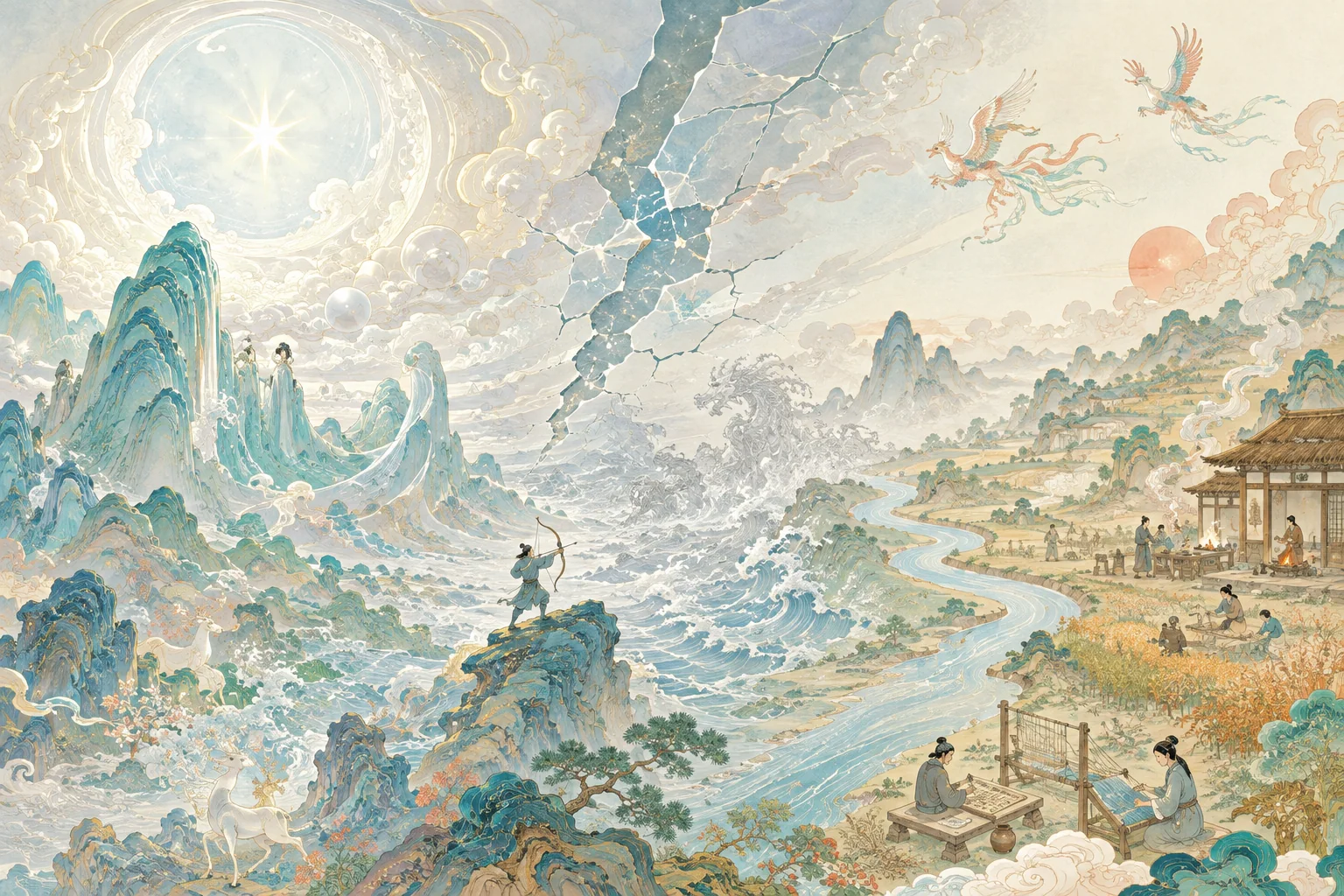
From Creation to Civilization: A Roadmap to Chinese Mythology
Chinese mythology is not a single book with a beginning, middle, and end. It is a layered memory, preserved in early texts, ritual traditions, local legends, religious stories, and later literature. Yet its many voices often move through a recognizable arc: the world is made, the world is threatened, extraordinary people repair it, and human communities learn how to live within it.
This roadmap follows four movements—Creation, Catastrophe, Heroes, and Civilization. It is a way to enter the tradition without flattening its regional and historical differences. The stories do not form one official canon; they echo one another across centuries.

1. Creation: Making a World That Can Be Inhabited
Creation myths ask more than “where did the universe come from?” They ask what kind of order makes life possible. In Chinese stories, cosmic order is often imagined as a balance of complementary forces: Heaven and Earth, yin and yang, light and shadow, water and land.
Pangu and the separation of Heaven and Earth
One of the best-known creation narratives tells of Pangu, a giant who awakens inside a cosmic egg. As the egg opens, the lighter substance rises and becomes Heaven, while the heavier substance settles and becomes Earth. Pangu stands between them, growing as the distance widens. When he finally dies, his body becomes part of the landscape: mountains, rivers, winds, and other features of the living world.
The story’s power lies in its image of creation as sustained labor. The universe is not simply switched on; it must be held apart and made stable. Pangu’s body also suggests that nature is not separate from mythic life. Mountains and rivers are transformed remains, carrying memory in physical form.
Nuwa and the making of human beings
Nuwa is frequently described as a creator and mother of humanity. In one tradition she shapes people from yellow earth. The careful figures she forms by hand become the honored classes, while a quicker method—dragging a cord through mud—produces people in greater numbers. The tale is both tender and socially observant: it imagines human variety while reflecting later ideas about hierarchy.
Nuwa’s creative role does not end with making people. When the cosmic structure is damaged, she becomes the one who restores it. Creation and repair are therefore linked: the maker is also responsible for the fragile world she brings into being.
Read alongside passages in the Huainanzi and the Classic of Mountains and Seas, these stories reveal a cosmos that is alive, relational, and continually negotiated.
2. Catastrophe: When the Cosmic Frame Breaks
If creation establishes balance, catastrophe shows how easily balance can fail. Chinese myths return again and again to floods, droughts, fires, rebellious waters, and collisions between rival powers. Disaster is rarely random. It usually exposes a broken relationship between Heaven, Earth, nature, and human conduct.
The struggle of Gonggong
In a famous account, the water deity Gonggong loses a struggle for power and rams his head into Mount Buzhou, one of the pillars supporting Heaven. The pillar breaks. The sky tilts, the earth cracks, and waters pour across the world. The image turns political conflict into a geological event: disorder in the realm of spirits becomes disorder in the landscape.
Nuwa repairs the sky
Nuwa responds by melting five-colored stones to mend the broken sky. She cuts off the legs of a giant turtle to replace the damaged supports, defeats a black dragon, and controls the floodwaters. Different versions vary in detail, but the central pattern remains: catastrophe requires a creator to become a restorer.
The repair is not a return to perfect symmetry. The world remains slightly tilted, which helps explain why rivers flow in particular directions and why the heavens and earth are not mirror images. Myth here preserves an insight familiar to lived experience: survival creates a new normal rather than restoring an untouched past.

The Great Flood and the work of Yu
The flood stories associated with Gun and Yu move catastrophe toward human history. Gun attempts to stop the waters by stealing miraculous soil, but fails. His son Yu succeeds through a different method: instead of blocking the flood, he channels it through a network of rivers and drainage works. Yu’s thirteen years of labor become a model of patient service, technical knowledge, and public responsibility.
The flood is therefore both a natural disaster and a test of leadership. In the Shiji, Yu’s authority grows from work that protects communities. The mythic hero is not merely a warrior; he is an engineer, organizer, and listener to the shape of the land.
3. Heroes: Figures Who Carry the World Forward
Chinese mythic heroes are often defined by what they do for others. Their gifts may be supernatural, but their legitimacy comes from sacrifice, discipline, or the ability to turn dangerous forces toward useful ends.
Yi and the ten suns
One day, ten suns rise into the sky and scorch the earth. The archer Yi shoots down nine, leaving one sun to illuminate the world. The episode appears in early sources such as the Huainanzi, where Yi’s skill protects crops, animals, and people from a cosmic excess.
Yi’s story is about proportion. The problem is not light itself but too much light. His arrows restore a livable measure, a recurring Chinese mythological idea in which harmony means regulated relationship rather than absolute victory.
Houyi, Chang’e, and the cost of immortality
Later traditions connect the archer Houyi with Chang’e, who flies to the moon after taking an elixir of immortality. The story has many versions: Houyi may be a flawed ruler, a beloved husband, or a tragic figure whose quest for permanence separates him from ordinary human life. Chang’e’s moon palace turns immortality into distance and longing.
These variations matter. Myth is not a fixed script but a conversation. A single figure can carry different emotional meanings—heroism, ambition, regret, or devotion—depending on the storyteller and period.
The culture heroes
Other heroes teach skills that make settled life possible. Shennong tastes plants to discover medicines and agriculture. The Yellow Emperor is remembered in later traditions as an organizer, inventor, and ancestor of institutions. Cangjie is credited with observing the traces of animals and creating writing. Whether or not these figures belong to historical memory, their stories express a common principle: civilization begins when knowledge is shared.

4. Civilization: Turning Survival into Culture
The final movement is not an ending. It is the continuing work of transforming a dangerous world into a meaningful home. Agriculture, medicine, writing, music, law, and ritual are all presented as technologies of belonging.
From landscape to society
Yu’s channels make land habitable. Shennong’s experiments make food and medicine dependable. The Yellow Emperor’s institutions give communities shared patterns. In these stories, civilization is not defined by buildings alone. It is a network of practices that lets people remember, cooperate, and respond to uncertainty.
Ritual as cosmic maintenance
Ritual maintains the relationship between human communities and the powers around them. Ancestor rites, seasonal festivals, offerings to local deities, and ceremonies for rain all preserve the idea that society exists within a larger living order. The boundary between “myth” and “religion” is therefore porous. A story can explain a mountain, authorize a ritual, and teach an ethical lesson at the same time.
Writing the myths again
Early collections such as the Shanhaijing preserve strange geographies and hybrid beings. Philosophical works reinterpret ancient figures as arguments about order and governance. Later novels, opera, painting, and popular religion continue to remake the old materials. The result is a tradition that grows by retelling.

How to Use This Roadmap
Follow the four movements as a spiral rather than a straight line. Creation contains the possibility of catastrophe; catastrophe calls forth heroes; heroic repair becomes civilization; civilization eventually faces new disorder. The same questions return in new forms: How is order made? What breaks it? Who takes responsibility? What knowledge allows a community to endure?
That is the larger arc of Chinese mythology—and the reason these stories remain alive. They are not only tales about gods in a distant past. They are imaginative tools for thinking about landscape, technology, leadership, family, memory, and the fragile work of making a world together.