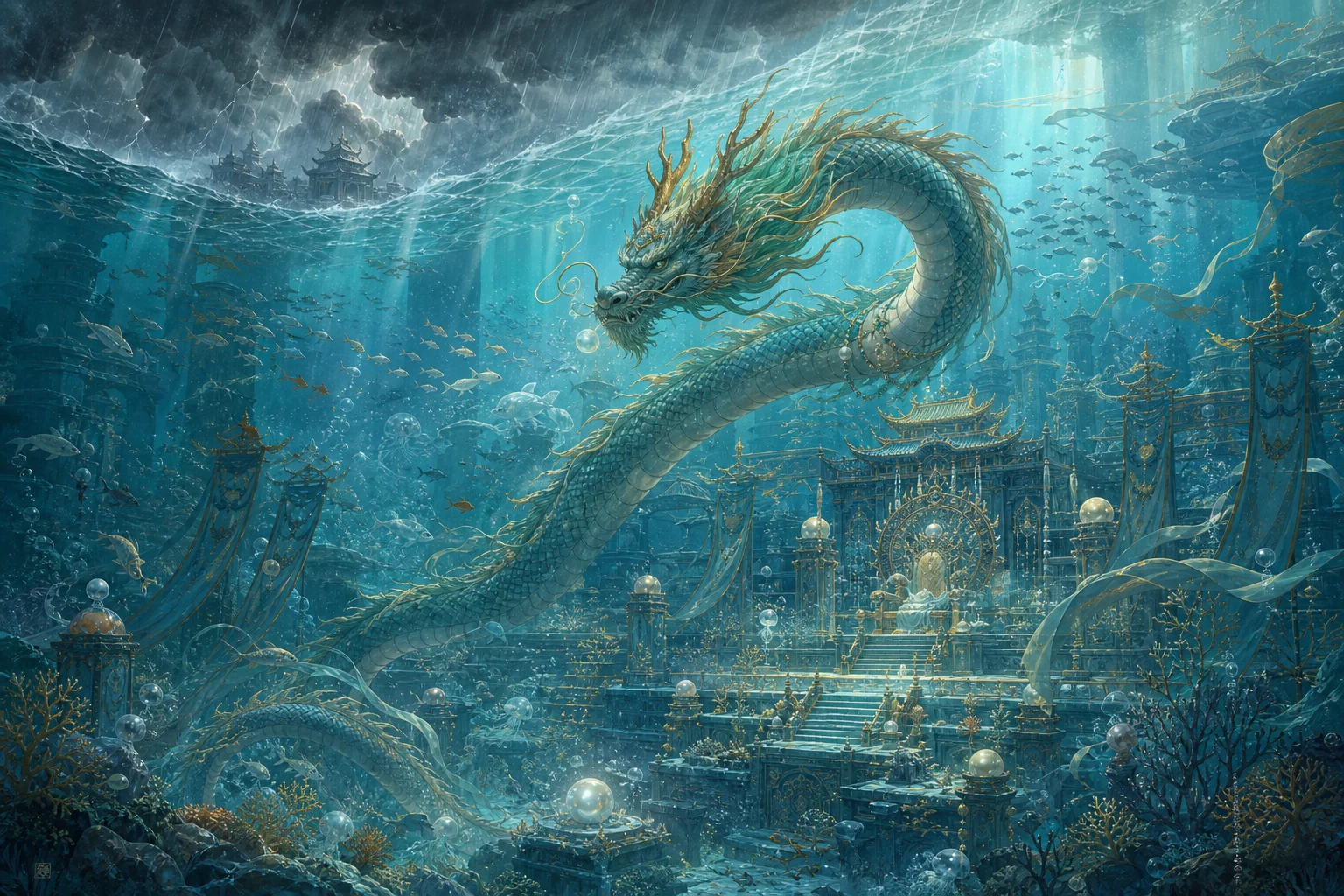
The Chinese long is most at home in moving water and cloud. Unlike the hoard-guarding dragons familiar from much European folklore, it is commonly associated with rain, rivers, seas, seasonal change, and beneficial power. Its body joins features of many creatures into one continuous, airborne form.
Dragon Kings give this elemental force a courtly identity. The best-known system places a king over each of the Four Seas, with the Dragon King of the Eastern Sea often taking the leading role. Beneath the waves stand palaces, treasuries, soldiers, ministers, and creatures of the deep—a watery reflection of administration on land and in heaven.
Weather as relationship
For agricultural communities, rain could mean survival, while flood or drought could bring disaster. Rituals and stories addressed dragon powers because weather was understood as a relationship requiring attention. Local dragon kings and river gods might be thanked, petitioned, criticized, or incorporated into official systems of worship.
This makes the dragon neither simply benevolent nor simply dangerous. Water nourishes and destroys; the same is true of the beings who govern it. Their authority must be balanced, just as channels, fields, and communities must balance the movement of water.
From local shrine to cosmic map
Dragon traditions vary enormously by region and period. A village spring, an imperial rain ritual, a temple procession, and a literary undersea court may all use dragon imagery differently. What connects them is the ability of the dragon to move between scales—from a single well to the ocean, from a storm cloud to the structure of the cosmos.