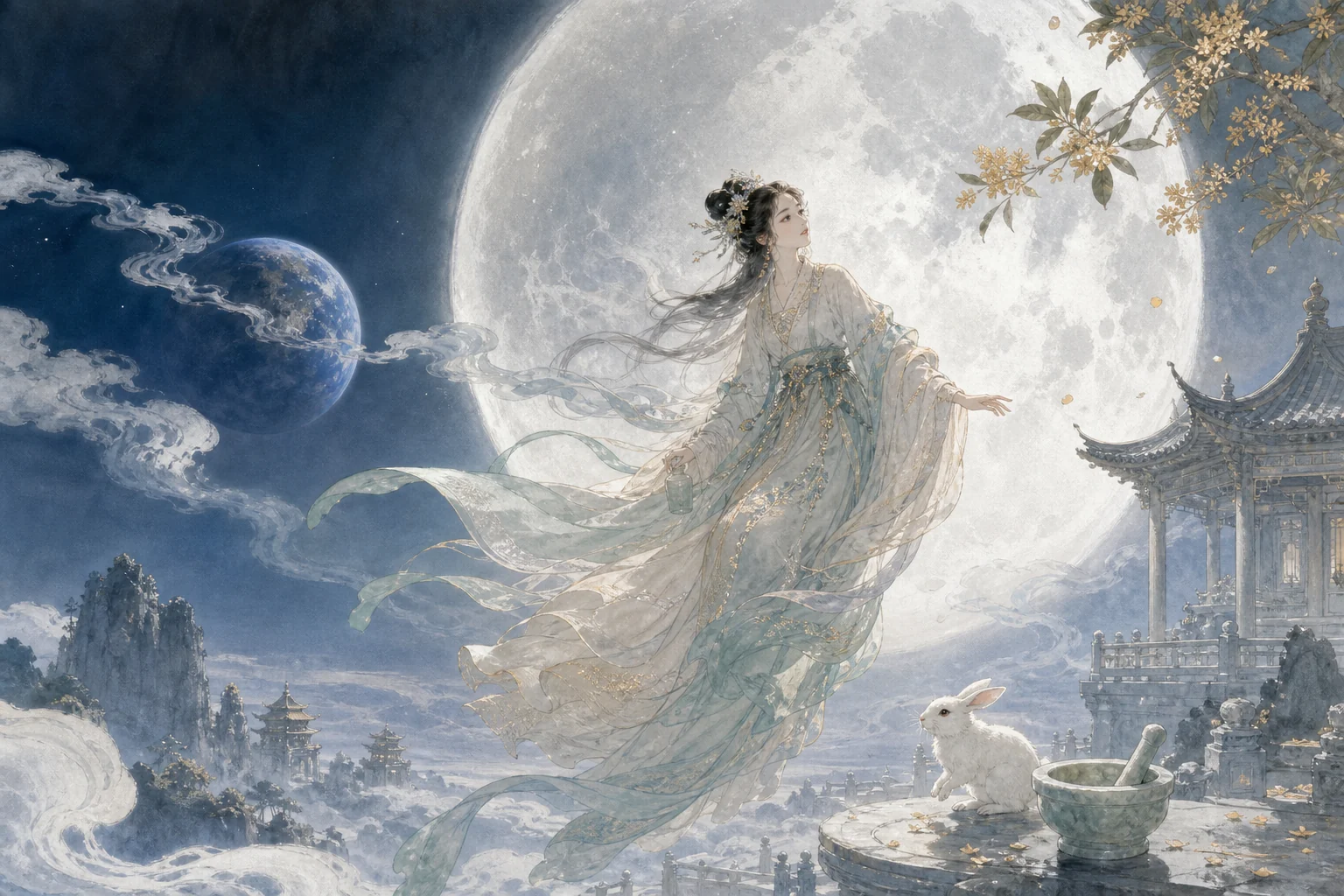
On the brightest autumn nights, Chang’e is imagined in the moon palace, far from the human world. Her story is inseparable from Hou Yi, the archer who saved the earth from the scorching heat of excess suns. An elixir of immortality enters their household, and from that point the tale divides into several famous versions.
In some tellings Chang’e takes the elixir to keep it from a thief; in others, desire or circumstance leads her to drink it. She grows light and rises beyond the roof, choosing—or being drawn toward—the moon. The difference matters: Chang’e can appear as protector, transgressor, exile, or seeker of immortality.
Companions in the moon
Chang’e is not alone in lunar imagination. The jade rabbit endlessly pounds medicine in a mortar, while the woodcutter Wu Gang labors at a cassia tree that heals as quickly as he cuts it. Together these figures make the moon a place of suspended time: medicine is prepared but never finished, a tree is cut but never felled, and reunion remains visible but distant.
That distance gives the story its emotional shape. Immortality solves the problem of death but creates another problem—separation. The cold radiance of the moon becomes beautiful because it is unreachable, and sorrowful because it can still be seen.
Looking up together
During the Mid-Autumn Festival, families gather, share mooncakes, and look at the same full moon from different places. Chang’e's tale gives that shared act a mythic depth. The moon represents absence and reunion at once: a remote palace, a familiar light, and a reminder that people separated by distance can still turn toward the same sky.